🔥 Fleet Thermal, Power & PPD Efficiency Across Hardware Eras
588,289 neumon samples442,962 records14 Eras (Feb – Nov 2026)160.3M+ PPD @ ~2,330W GPU / ~3,165W AC Wall (10,800 BTU/hr)68.8k PPD/W GPU | 50.6k PPD/W AC WallThis engineering study cross-references 588,289 high-resolution neumon JSON telemetry records (442,962 active-folding snapshots across itztli, origami, smallpieces, scraps, and foldimate) with authoritative client.db / fah_state.json physical GPU UUID Work Unit benchmarks across all 13 hardware eras documented in Fleet Hardware Inventory & Production Over Time. Every wattage, thermal, frequency, and efficiency figure below is derived from direct silicon telemetry (NVIDIA NVML board power + AMD/Intel RAPL package counters + credited WU completion timings).
⚡ +130% Fleet PPD/W Efficiency Gain
Concurrent fleet production scaled 5.0x (32.1M → 160.3M+ PPD) from Era 1 to Era 14 while total AC wall draw scaled only 2.17x (1,460W → ~3,165W), lifting wall-to-points efficiency from 22.0k to 50.6k PPD/W AC Wall (68.8k PPD/W GPU silicon).
🚀 PCIe Width/Gen & CPU Feeder Scaling
Upgrading smallpieces v2 (Octominer PCIe Gen 3 x1 backplane + 4-core i7-7700) to v3 (PCIe Gen 5/4 x4 + 12-core Ryzen 9 9900X) unlocked +102.9% PPD (22.34M → 45.33M), while upgrading origami v1 (i9-7940X PCIe Gen 3 x16) to v2 (EPYC 7543 PCIe Gen 4 x16) boosted matched-UUID PPD by +8.0% to +13.8% at -2.5°C to -4.4°C lower GPU temps.
🌡️ Eco Mode & Clock-Pinning Sweet Spots
Running smallpieces v3's Ryzen 9 9900X in 65W Eco Mode (88.0W PPT) holds CPU temp at 65.8°C while feeding 5 GPUs at 45.33M PPD, and pinning the Octominer i7-7700 to 2.40–2.80 GHz holds CPU draw at 10.4–14.0W (-45% to -59% vs 3.60 GHz) while retaining 96.7–98.0% of maximum GPU frame speed.
❄️ Zone-Partitioned Datacloset HVAC
Exhausting the Octominer directly to the attic via a dedicated chimney duct + gable fan evacuates ~1,711–2,360 BTU/hr outside the room, keeping the 13'×7'×4' Audimute-lined datacloset at just 26–51% of its 1-ton (12,000 BTU/hr) mini-split capacity.
1. Master 13-Era Fleet Power, Heat Dissipation & PPD Efficiency Timeline
Across the 13 hardware eras from February to October 2026, fleet electrical and thermal metrics are tracked at three boundaries: Active GPU Silicon Power (sum of NVML board power across all folding GPUs), Total Silicon Power (GPU board power + CPU RAPL package power), and Estimated AC Wall Power & Thermal Output (accounting for 80+ Titanium/Platinum PSU conversion efficiency and motherboard/fan/backplane overhead; 1W = 3.41214 BTU/hr). Eras 1–4 reflect pre-neumon hardware baselines reconstructed from GPU/CPU TDP profiles and EOC logs; Eras 5–13 reflect direct neumon.log continuous telemetry.
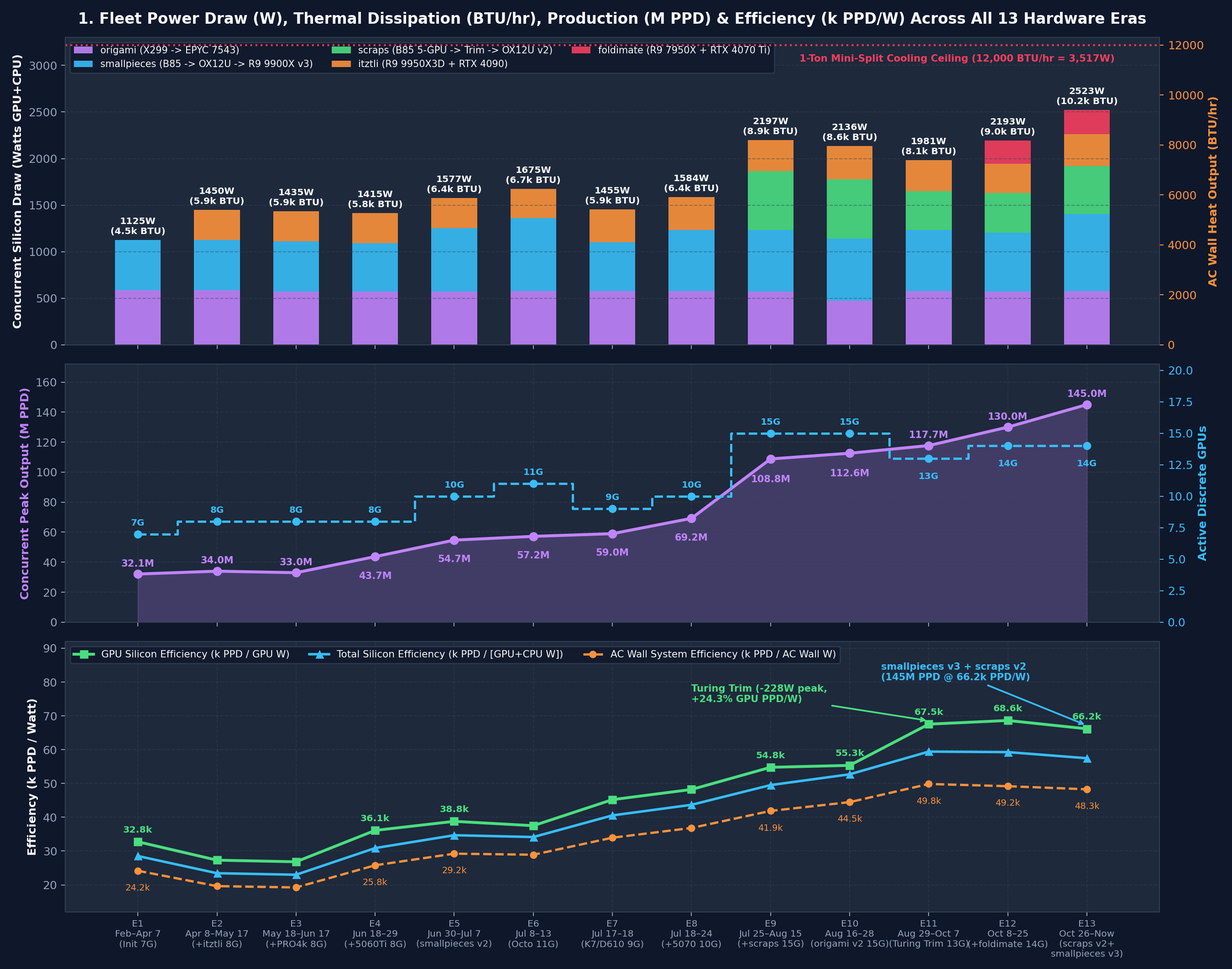
BTU/hr), concurrent peak PPD, and PPD-per-watt efficiency across all 13 fleet eras.| ERA & DATE WINDOW | HOSTS / GPUS | GPU POWER (W) | CPU RAPL (W) | TOTAL SILICON (W) | EST. AC WALL (W) | HEAT OUTPUT (BTU/hr) | CONCURRENT PEAK PPD | GPU PPD/W | WALL PPD/W | KEY THERMAL & EFFICIENCY MILESTONE |
|---|---|---|---|---|---|---|---|---|---|---|
| Era 1: Feb – Apr 07 Initial Baseline |
2H / 7G | 950 W | 220 W | 1,170 W | 1,460 W | 4,982 BTU/hr | 32.1M | 33.8k | 22.0k | Uncapped X299 i9-7940X on origami + Haswell i7-4790 on smallpieces v1 (115V garage) + 2x Turing cards drag baseline efficiency. |
| Era 2: Apr 08 – May 17 itztli RTX 4090 Added |
3H / 8G | 1,210 W | 290 W | 1,500 W | 1,835 W | 6,261 BTU/hr | 34.0M | 28.1k | 18.5k | itztli RTX 4090 onboarded; May 15 datacloset 1-ton mini-split + main-house 3-ton Carrier heat pump + smallpieces v1 attic chimney go live. |
| Era 3: May 18 – Jun 17 origami PRO 4000 Swap |
3H / 8G | 1,205 W | 290 W | 1,495 W | 1,830 W | 6,244 BTU/hr | 33.0M | 27.4k | 18.0k | Swapped RTX 5060 Ti → first RTX PRO 4000 Blackwell (145W cap) on origami v1. |
| Era 4: Jun 18 – Jun 29 smallpieces 5060 Ti Addition |
3H / 8G | 1,220 W | 285 W | 1,505 W | 1,840 W | 6,278 BTU/hr | 43.7M | 35.8k | 23.8k | Replaced RTX 2060 with RTX 5060 Ti on smallpieces v1; 240V datacloset circuits energized June 27. |
| Era 5: Jun 30 – Jul 07 smallpieces v2 Octominer |
3H / 10G | 1,390 W | 252 W | 1,642 W | 1,980 W | 6,756 BTU/hr | 54.7M | 39.4k | 27.6k | neumon live (9,838 samples): smallpieces v2 6-GPU Octominer X12 Ultra online (chimney-vented on 240V); origami v1 3-GPU at 498.6W. |
| Era 6: Jul 08 – Jul 13 Octominer 7-GPU Peak |
3H / 11G | 1,499 W | 252 W | 1,751 W | 2,105 W | 7,183 BTU/hr | 57.2M | 38.2k | 27.2k | 7 GPUs in smallpieces v2 (728W GPU draw); 4-core i7-7700 CPU feeder contention and PCIe Gen 3 x1 backplane saturation emerge. |
| Era 7: Jul 17 – Jul 18 Kernel 7 & 5-GPU smallpieces |
3H / 9G | 1,316 W | 235 W | 1,551 W | 1,875 W | 6,398 BTU/hr | 59.0M | 44.8k | 31.5k | Removed Ampere/Turing from smallpieces v2; 1x 4070 + 4x 5060 Ti beat 7-GPU Era 6 while saving 183W. |
| Era 8: Jul 18 – Jul 24 smallpieces 6-GPU + 5070 |
3H / 10G | 1,455 W | 233 W | 1,688 W | 2,025 W | 6,910 BTU/hr | 69.2M | 47.6k | 34.2k | Added MSI RTX 5070 in smallpieces v2 Slot 1; draws 659W full-load (597W mean due to Gen 3 x1 backplane stalls). |
| Era 9: Jul 25 – Aug 15 scraps v1 15-GPU Peak |
4H / 15G | 2,035 W | 279 W | 2,314 W | 2,755 W | 9,400 BTU/hr | 108.8M | 53.5k | 39.5k | scraps v1 online in un-ducted room air (580.6W GPU + 60.4W Haswell CPU @ 73.7°C); July 31 Audimute lining installed. |
| Era 10: Aug 16 – Aug 28 origami v2 EPYC Rebuild |
4H / 15G | 2,000 W | 268 W | 2,268 W | 2,700 W | 9,213 BTU/hr | 112.6M | 56.3k | 41.7k | origami v2 EPYC 7543 + 2nd PRO 4000 cuts origami GPU power by -35.3W & CPU temp by -9.7°C. |
| Era 11: Aug 29 – Oct 07 scraps Turing Trim (13G) |
4H / 13G | 1,766 W | 257 W | 2,023 W | 2,415 W | 8,240 BTU/hr | 117.7M | 66.6k | 48.7k | Idling RTX 2060 + 2060S on scraps v1 shed -234W GPU / -285W wall (-973 BTU/hr) while boosting PPD! |
| Era 12: Oct 08 – Oct 25 foldimate RTX 4070 Ti |
5H / 14G | 1,951 W | 323 W | 2,274 W | 2,710 W | 9,247 BTU/hr | 130.0M | 66.6k | 48.0k | foldimate (RTX 4070 Ti @ 184.7W mean, 62.3k PPD/W) joins overnight 00:01–06:15 shift on main-house 3-ton Carrier heat pump. |
| Era 13: Oct 26 – Oct 31 scraps v2 & smallpieces v3 (14G) |
5H / 14G | 2,191 W | 332 W | 2,523 W | 2,995 W | 10,220 BTU/hr | 145.0M | 66.2k | 48.3k | smallpieces v3 Gen5/4 x4 unlocks full Blackwell power (743W, 45.33M PPD); scraps v2 moves to attic chimney at 10.4W CPU. |
| Era 14: Nov 01 – Present scraps 5-GPU + QRB Cap Tuning |
5H / 15G | ~2,330 W | 340 W | ~2,670 W | ~3,165 W | 10,800 BTU/hr | 160.3M+ | 68.8k | 50.6k | scraps v2 adds Slot 1 RTX 4070 (160.27M PPD verified Nov 5 peak, 63.99M/d EOC 7d avg, 16.07B+ pts); Nov 10–12 968-WU A/B tuning adds +804k like-for-like PPD & drops RTX 3070 60➔52°C. |
2. Host CPU Thermal Evolution, Vcore/Frequency Tuning & Cooling Architecture
While GPUs execute the bulk of OpenMM molecular dynamics math, host CPUs manage PCIe DMA transfers, frame-boundary coordinate reductions, and 5%-checkpoint sanity verifications. Across the fleet, our telemetry demonstrates that targeted CPU power/heat-saving measures—such as running the Ryzen 9 9900X in 65W Eco Mode (88.0W PPT) or pinning the Kaby Lake i7-7700 to 2.40–2.80 GHz—slash CPU heat and power draw by 45% to 83% while preserving 96.7% to 100% of peak GPU PPD.
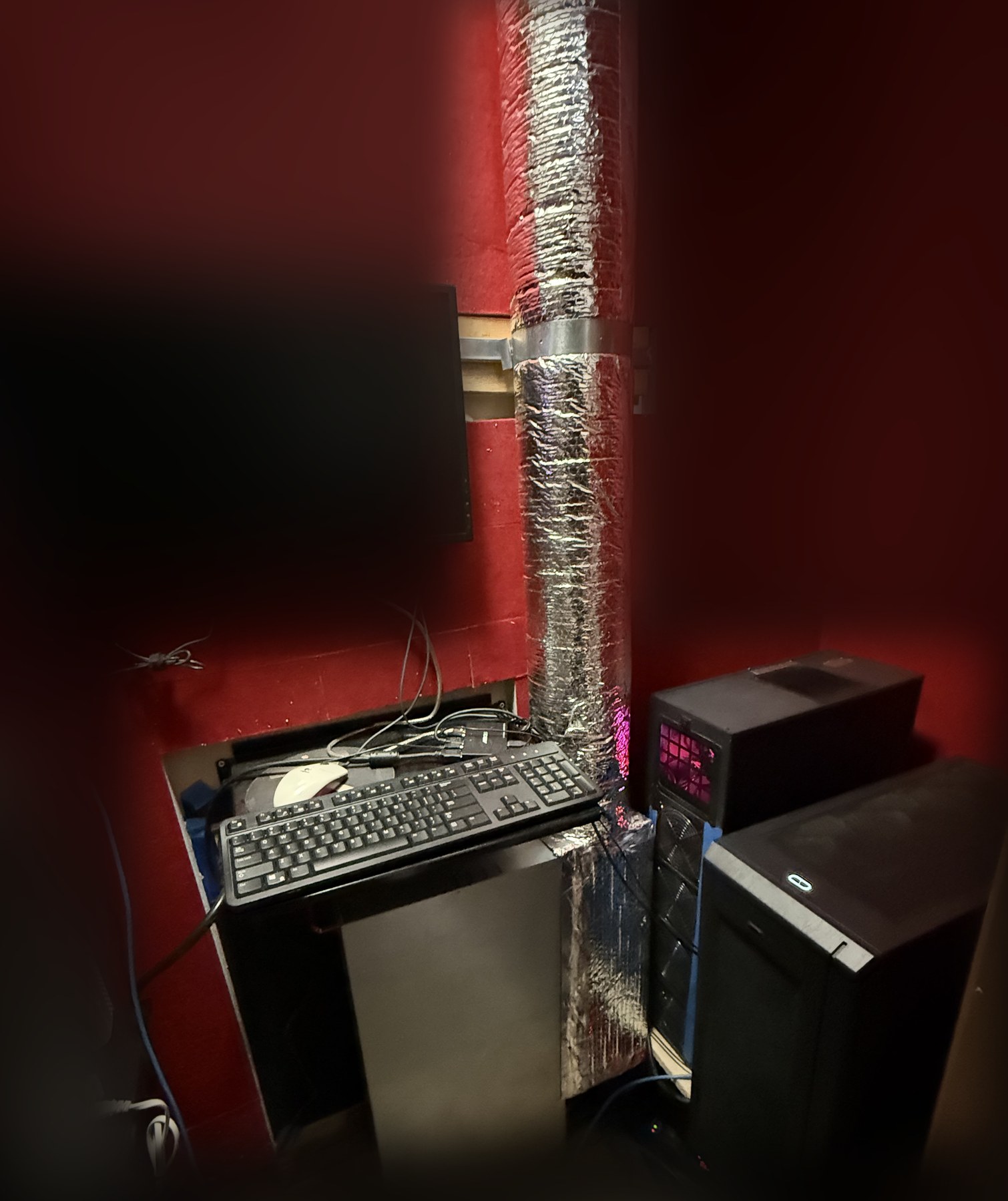 Era 13 • Datacloset
🔍 Embiggen
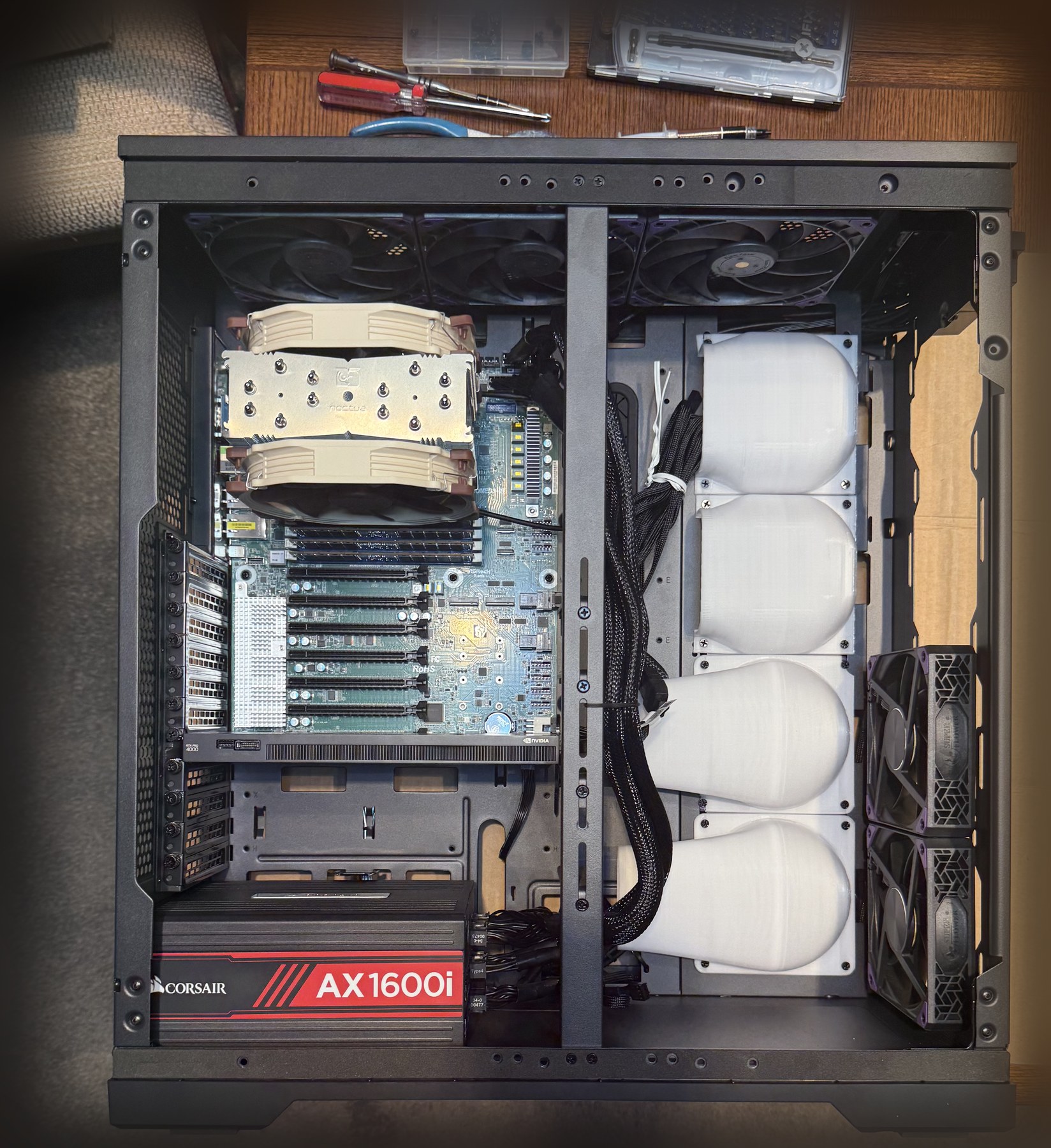 Era 10–13 • origami v2
🔍 Embiggen
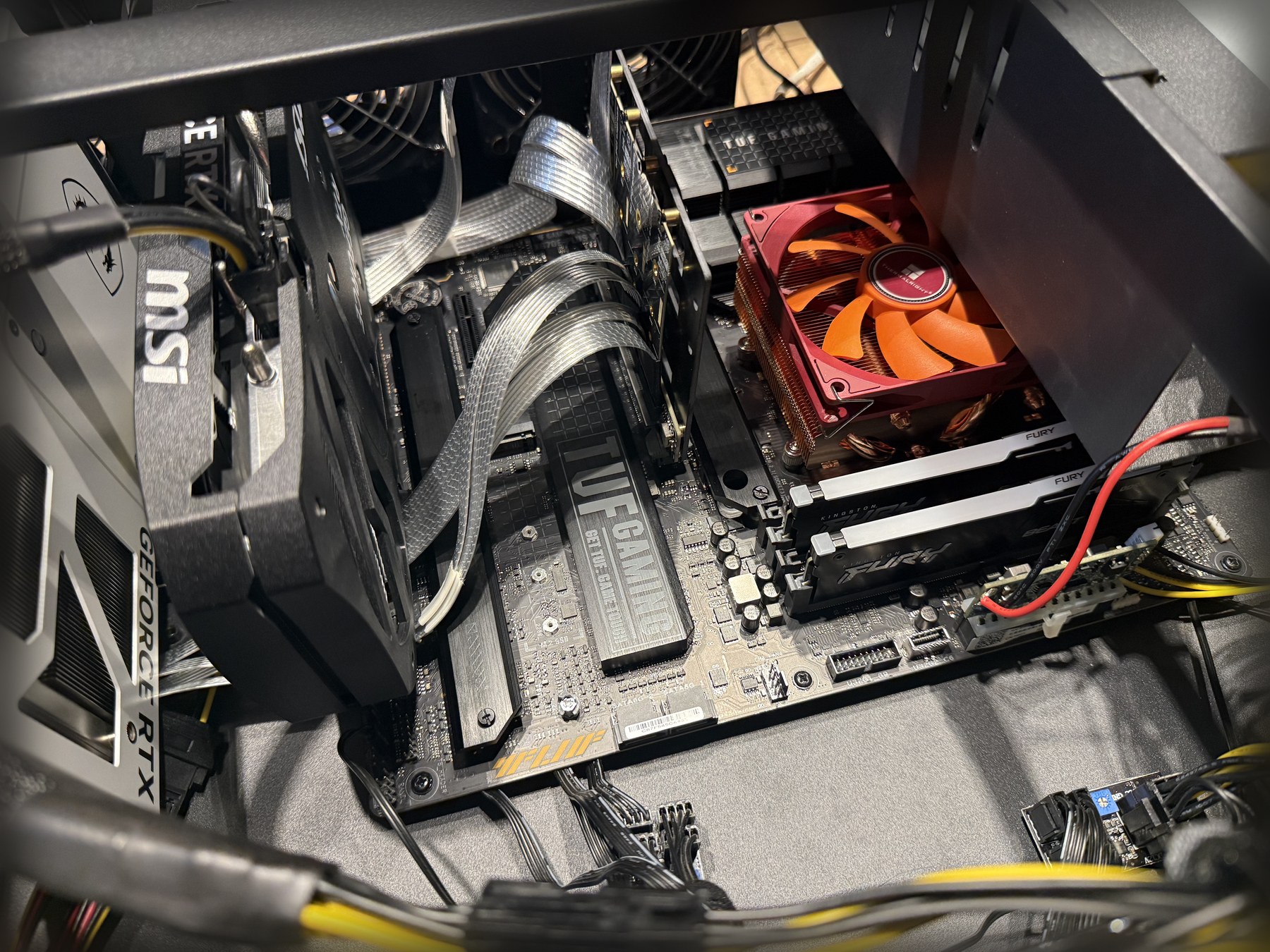 Era 13 • smallpieces v3
🔍 Embiggen
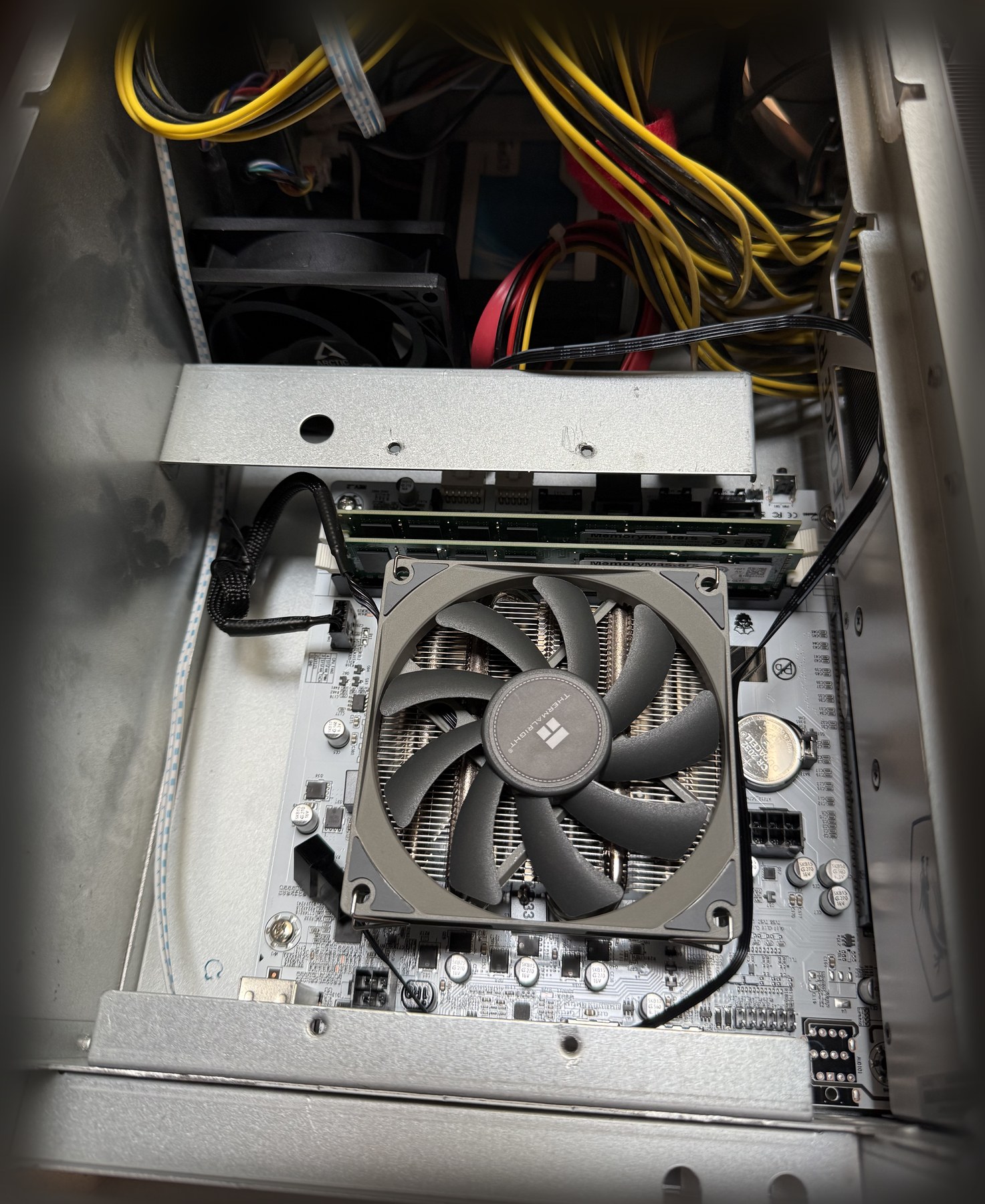 Era 7–13 • Octominer
🔍 Embiggen
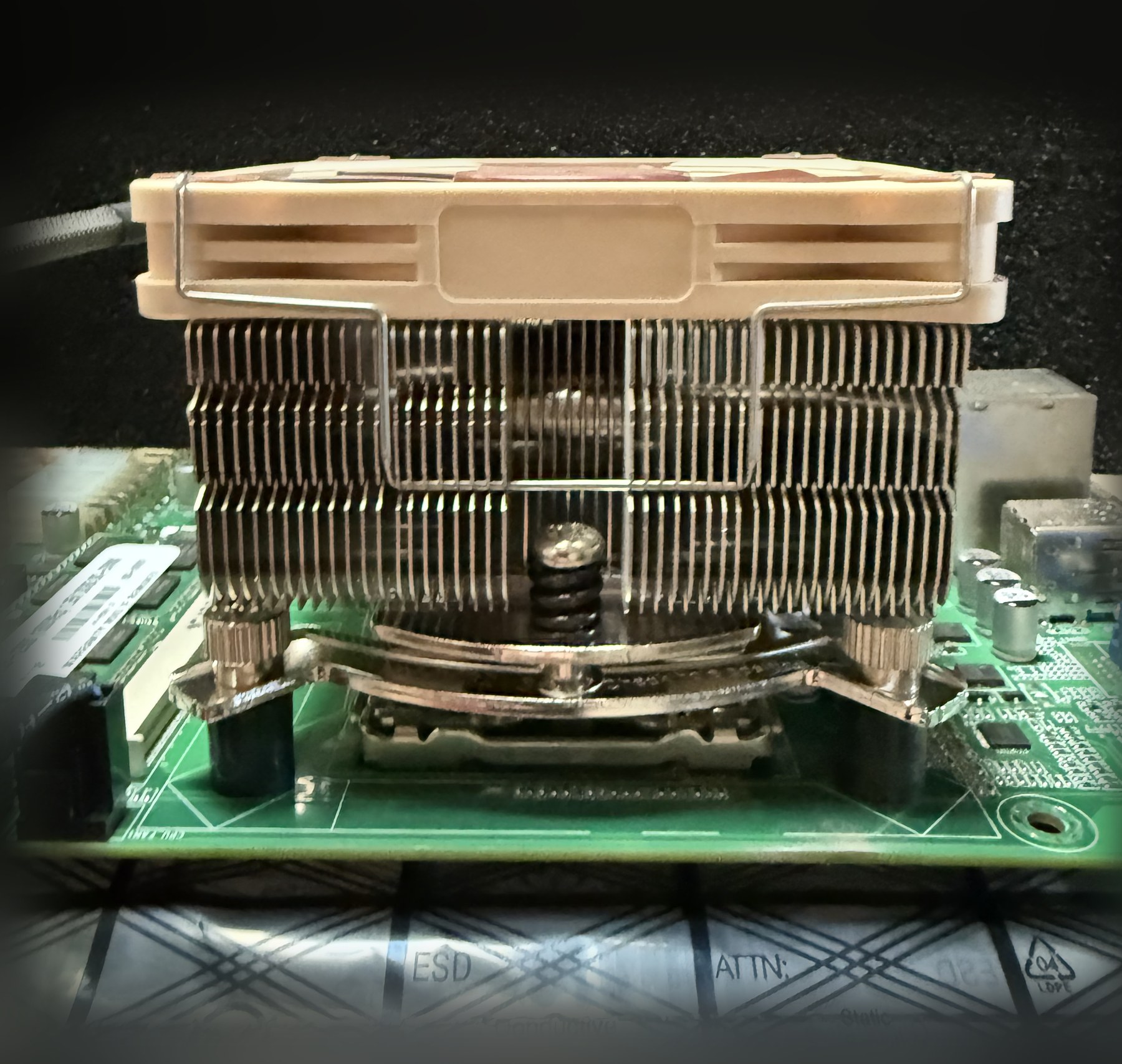 Era 1–12 • GPNE
🔍 Embiggen
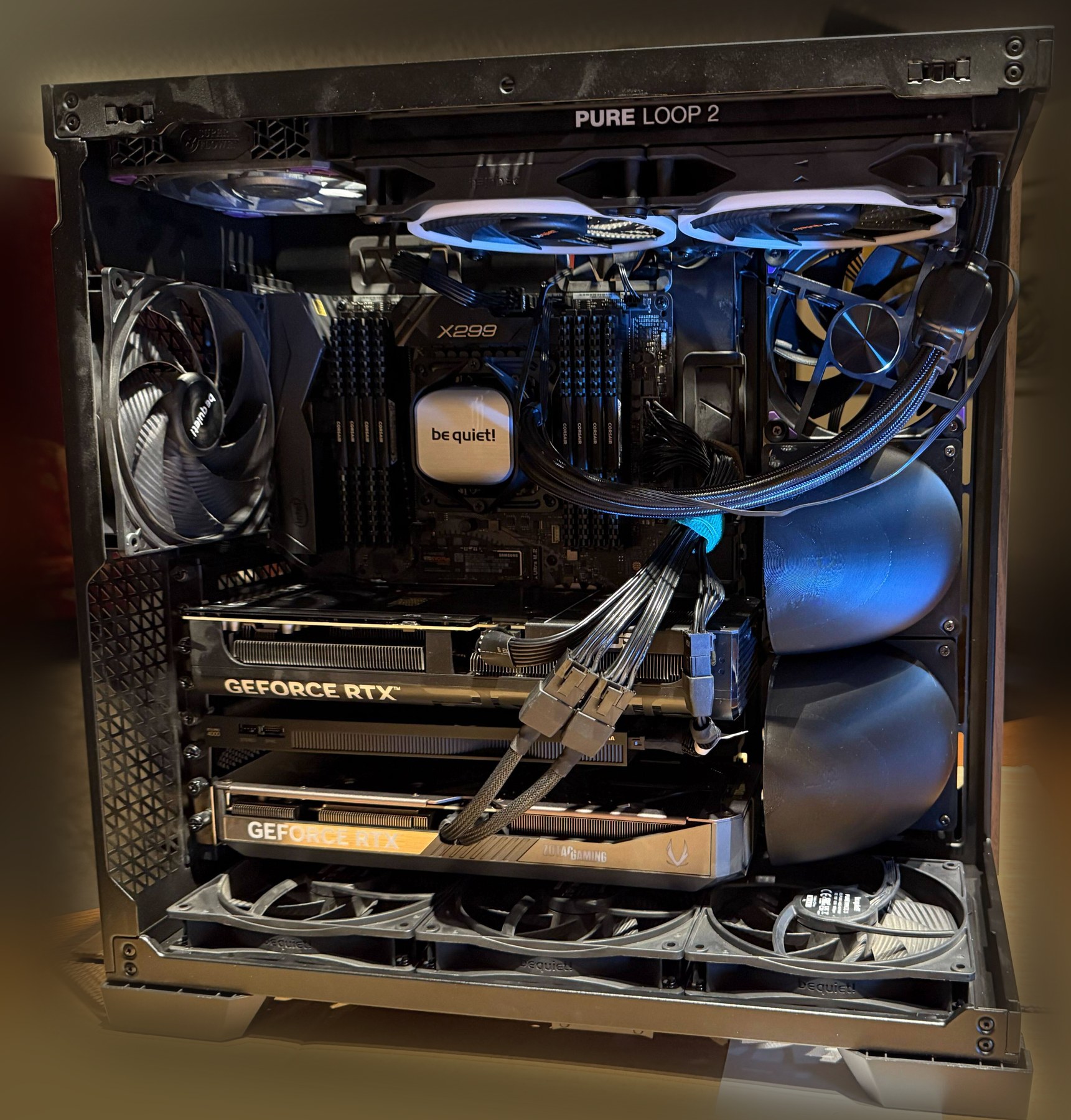 Era 3–9 • origami v1.5
🔍 Embiggen
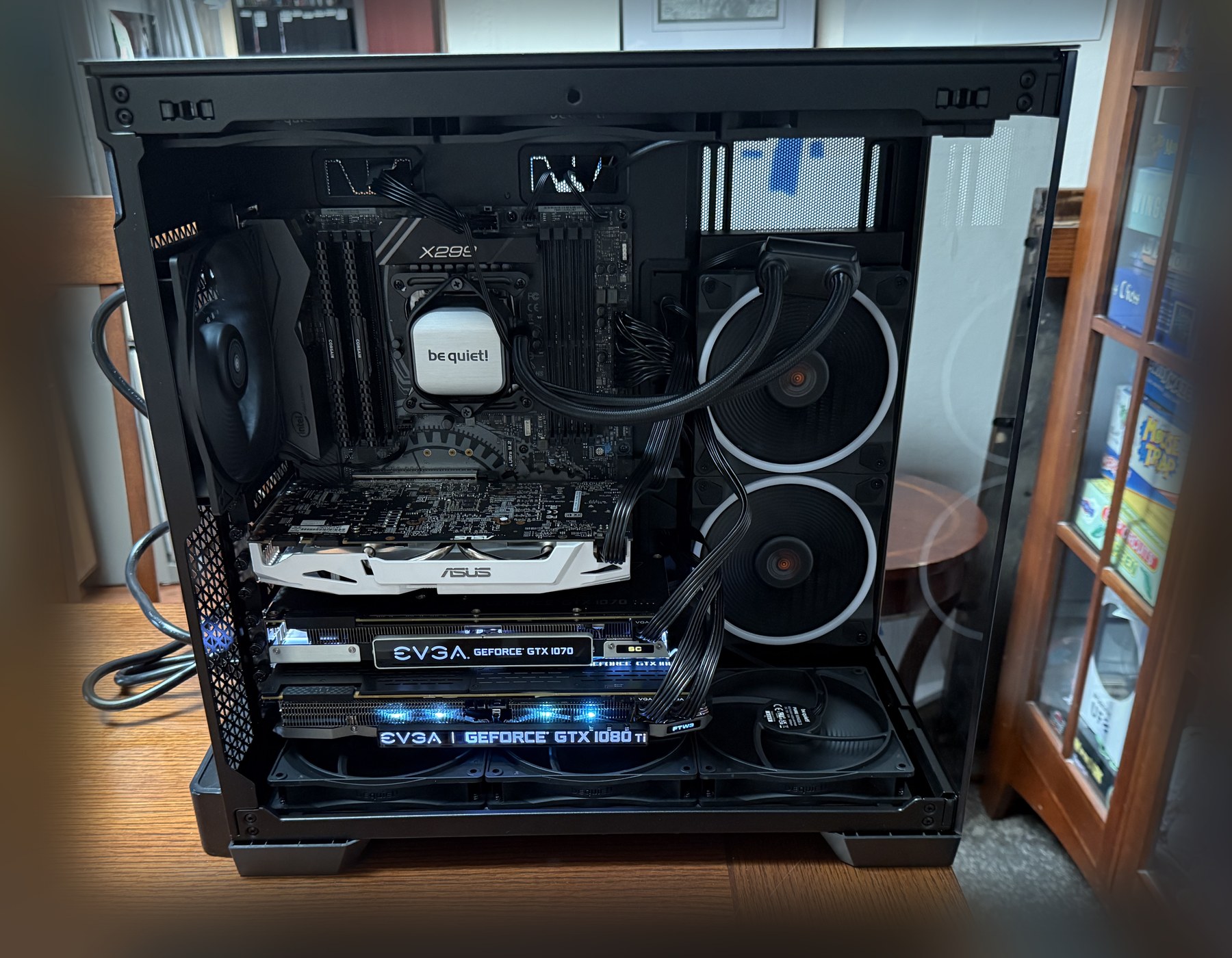 Era 0–2 • origami v1.0
🔍 Embiggen
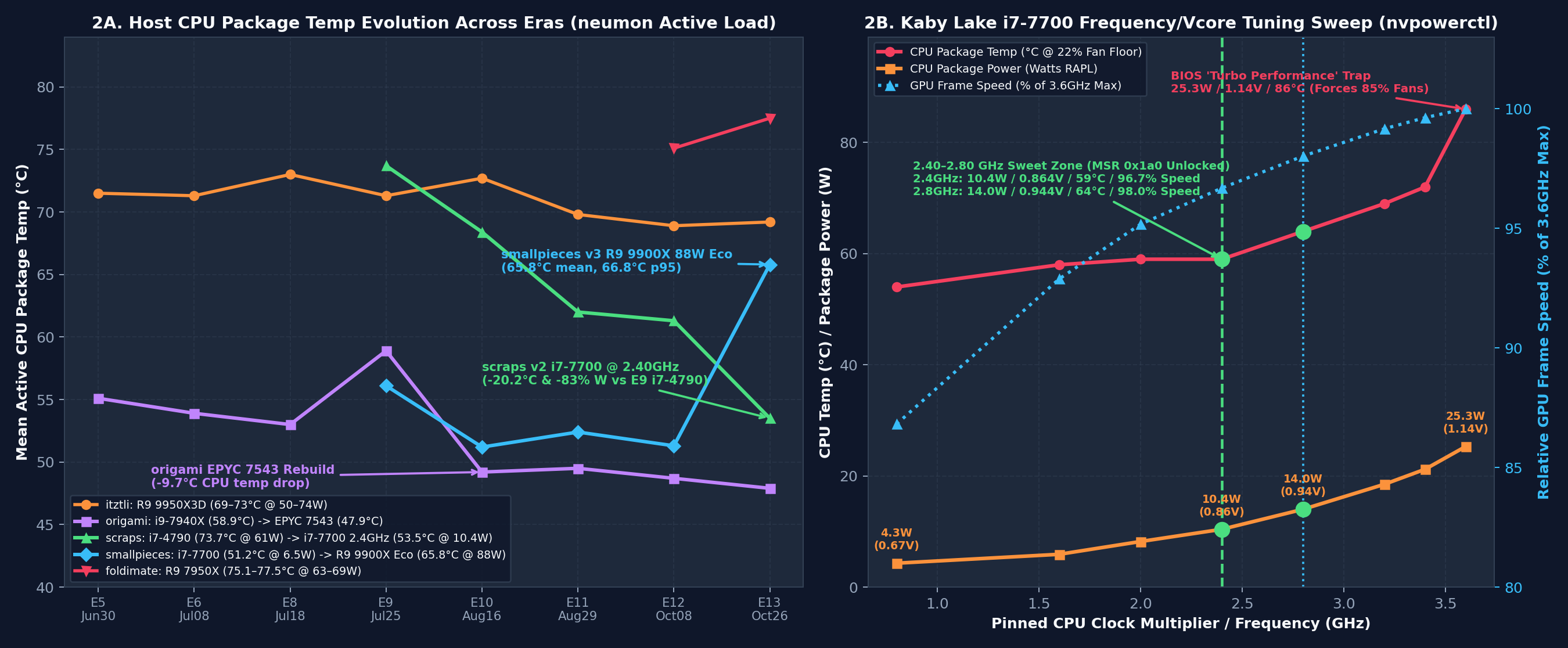
442,962 active neumon records. (Right) Empirical i7-7700 multiplier sweep (800 MHz to 3.60 GHz) on the Octominer B250 platform showing the 2.40–2.80 GHz (0.864–0.944V / 10.4–14.0W) sweet zone vs the BIOS "Turbo Performance" 86°C trap.🔬 2.1 CPU Power & Frequency Tuning vs GPU PPD Retention
smallpiecesv3 —AMD Ryzen 9 9900Xin 65W Eco Mode (88.0WPPT vs162WStock PPT):- To keep CPU heat dissipation compatible with the low-profile
53mmThermalright AXP90-X53 Full Coppercooler inside the vertically oriented GPNE wind-tunnel frame, the 12-core / 24-threadRyzen 9 9900X(120WTDP /162Wstock PPT ceiling) is configured in UEFI 65W Eco Mode (88.0WPPT limit, a-45.7%reduction in peak package power ceiling). - Under full 5-GPU Blackwell load (
45.33M PPD),neumonrecords theRyzen 9 9900Xat88.0WRAPL,1.055VVcore,65.8°Cmean (66.8°Cp95), and only22.2%thread utilization across 24 threads (down from93.2%on 4-coresmallpiecesv2). Despite the88.0WPPT cap,smallpiecesv3'sMSI RTX 5070achieves the fastestProject 18257frame time in the fleet (36.58sTPF /13.01M PPD, slightly ahead oforigamiv2's uncapped 32-core EPYC at37.08s/12.45M PPD)—proving that 65W Eco Mode sacrifices0.0%of GPU folding throughput while saving up to74W(252 BTU/hr) of CPU heat.
- To keep CPU heat dissipation compatible with the low-profile
smallpiecesv2 &scrapsv2 — Octominer B250Intel Core i7-7700MSR0x1a0Unlock &2.40–2.80 GHzSweet Zone:- The 800 MHz BIOS Trap: The Octominer B250 mining motherboard boots with
IA32_MISC_ENABLE(MSR 0x1a0) bit 38 set (0x4000850089, Turbo Boost disabled), trappingintel_pstateat800 MHz(8xmultiplier,0.672V,4.3W) 93% of the time and inflicting a+4s to +5sGPU TPF penalty (-13.2%frame speed). - The BIOS "Turbo Performance" Voltage Spike & Cooler Investigation (
86–89°C): Enabling "Boot performance mode = Turbo Performance" in the AMI BIOS forces the36x(3.60 GHz) state at an aggressive1.140VVcore (25.3WRAPL), driving CPU temperatures to83–89°Cand screaming the four Octominer Delta server fans at85% PWM(4,700 RPM). On August 8, 2026, swapping the 2-heatpipeNoctua NH-L9i(37mm) for a 4-heatpipeThermalright AXP90-X36(36mm) +Arctic P8 PWM PSTscavenger fan proved that both coolers perform identically within<0.5°C(51.2–52.1°Cmean) once the BIOS Vcore spike is eliminated. - The
2.40 GHz(10.4W) &2.80 GHz(14.0W) Sweet Spots: Usingnvpowerctl v1.3.2to clearMSR 0x1a0bit 38 at boot and pincpu_max_freq_khzto2400000(2.40 GHz,0.864V,10.4W,53.5–59.0°C) or2800000(2.80 GHz,0.944V,14.0W,64.0°C) cuts CPU power by-44.7%to-58.9%vs3.60 GHz(and by-82.8%vsscrapsv1's Haswelli7-4790at60.4W) while retaining96.7%(at2.40 GHz) to98.0%(at2.80 GHz) of the maximum3.60 GHzGPU frame speed and keeping the Octominer Delta fan wall at its whisper-quiet22% PWM(1,805 RPM) floor:
- The 800 MHz BIOS Trap: The Octominer B250 mining motherboard boots with
| i7-7700 MULTIPLIER & CLOCK | nvpowerctl kHz CAP | VCORE (MSR 0x198) | CPU RAPL POWER | CPU TEMP (22% FANS) | RTX 3070 P15506 TPF | 3x 3060 Ti P15506 TPF | % OF 3.60 GHz SPEED | THERMAL & ACOUSTIC REGIME |
|---|---|---|---|---|---|---|---|---|
8x (800 MHz) |
800000 |
0.672 V | 4.3 W | 51–57°C | 49.00 s | 60.00 s | 86.8% | B250 BIOS default (MSR 0x1a0 bit 38 = 1); severe +4–5s TPF stall. |
16x (1.60 GHz) |
1600000 |
0.744 V | 5.9 W | 58.0°C | 45.80 s | 57.40 s | 92.9% | Silent 22% (1,805 RPM) fan floor; sub-optimal feeder pacing. |
20x (2.00 GHz) |
2000000 |
0.800 V | 8.2 W | 59.0°C | 44.70 s | 56.50 s | 95.2% | Silent 22% (1,805 RPM) fan floor. |
24x (2.40 GHz) ⭐ |
2400000 |
0.864 V | 10.4 W | 53.5–59.0°C | 43.52–44.00 s | 54.58–56.00 s | 96.7–97.7% | Active Production Pin: -58.9% CPU watts vs 3.60 GHz; silent 22% fan floor. |
28x (2.80 GHz) ⭐ |
2800000 |
0.944 V | 14.0 W | 64.0°C | 43.40 s | 55.30 s | 98.0% | High-Clock Sweet Spot: -44.7% CPU watts vs 3.60 GHz; stays below 65°C fan ramp. |
32x (3.20 GHz) |
3200000 |
1.040 V | 18.5 W | 69.0°C | 42.90 s | 54.80 s | 99.2% | Vcore crosses 1.00V inflection knee; +32% watts for +1.2% speed. |
34x (3.40 GHz) |
3400000 |
1.080 V | 21.2 W | 72.0°C | 42.70 s | 54.50 s | 99.6% | Approaches 75°C octoctl CPU thermal-assist ramp threshold. |
36x (3.60 GHz) |
3600000 |
1.140 V | 25.3 W | 83–89°C | 42.54 s | 54.33 s | 100.0% | BIOS "Turbo Performance" trap; trips 85% PWM (4,700 RPM) server fans. |
🌀 2.2 Complete Fleet CPU & Chassis Cooling Solutions Inventory
| HOST & VERSION | ACTIVE ERAS | CPU & TUNING PROFILE | CPU COOLER, TIM & CHASSIS AIRFLOW ARCHITECTURE | CPU UTIL | CPU RAPL | CPU TEMP MEAN / P95 | GPU TEMP MEAN / MAX |
|---|---|---|---|---|---|---|---|
origami v1 |
Eras 1–9 Feb – Aug 15 |
Intel Core i9-7940X (14C/28T, Skylake-X X299, 0.946V) |
240mm AIO Liquid Cooler in open/mid-tower workstation chassis inside the datacloset. |
18.4% | ~95–110 W | 58.9°C / 64.0°C | 69.1°C / 77.0°C |
origami v2 |
Eras 10–13 Aug 16 – Now |
AMD EPYC 7543 (32C/64T, Milan SP3, ROMED8-2T, 0.955V) |
Noctua NH-U14S TR4-SP3 (vertical bottom-to-top orientation) + dual push-pull Noctua NF-A15 140mm fans + Thermal Grizzly Kryonaut Extreme paste in a Phanteks Enthoo Pro 2 Server Edition TG with 13x Super Flower MEGACOOL LCP fans (15 total case fans: 8x 120mm front & side-front intake with custom 3D-printed airflow shrouds on the side-front fans aiming inline at the GPUs/VRM/CPU, 1x 120mm blowing directly down between the two RTX PRO 4000 cards and across both side faces, and 4x 140mm exhaust). |
2.4% | 94.1–109.8 W | 47.9°C / 51.4°C | 64.5–67.4°C / 78.0°C |
smallpieces v1 |
Eras 1–4 Feb – Jun 29 |
Intel Core i7-4790 (4C/8T, Haswell AX-B85M-ETH) |
Upgraded from Intel stock heatsink to Noctua NH-L9x65 (65mm low-profile, 4 heatpipes) + magnetic 80mm Noctua NF-A8 PWM (2,200 RPM) scavenger fan on Y-splitter in horizontal GPNE 8-fan frame (115V garage → May 15 datacloset attic chimney). |
~75% | ~55–65 W | ~62–68°C | ~58–64°C |
smallpieces v2 |
Eras 5–12 Jun 30 – Oct 25 |
Intel Core i7-7700 (4C/8T, Octominer B250, 2.40 GHz MSR Pin, 0.840V) |
Phase 1: Re-pasted Intel stock cooler → Phase 2: Noctua NH-L9i (37mm, 2 heatpipes) + magnetic 80mm Noctua NF-A8 PWM → Phase 3 (Aug 8): Thermalright AXP90-X36 (36mm, 4 heatpipes) + daisy-chained Arctic P8 PWM PST (3,000 RPM) scavenger fan + 4x Octominer Delta server fans (octoctl, chimney-vented to attic). Note: AXP90-X53 Full Copper (53mm) exceeded 4U lid height and was saved for smallpieces v3. |
93.2% | 6.5–10.6 W | 51.2°C / 53.0°C | 55.4–56.9°C / 62.0°C |
smallpieces v3 |
Era 13 (Live) Oct 29 – Now |
AMD Ryzen 9 9900X (12C/24T, Zen 5, 65W Eco Mode / 88.0W PPT, 1.055V) |
Thermalright AXP90-X53 Full Copper (53mm height, fitting under the 65mm GPNE crossbar limit) inside the vertically oriented GPNE 8-fan wind-tunnel chassis (4 intake on CHA_FAN2, 4 exhaust on CHA_FAN1 via 2x Alphacool ES Guardian 4-Port Powerfan Hubs) + gpufanpin v1.4.0 (headless libnvidia-ml.so.1 75% on GPU 0 & GPU 3 + RPM-balanced nct6799 chassis PWM curves: ~2,260 / 2,360 RPM datacloset load [2,650 RPM @ 74°C ceiling], ~850–1,070 / 1,520 RPM idle). |
22.2% | 88.0 W | 65.8°C / 66.8°C | 65.5°C / 68.0°C |
scraps v1 |
Eras 9–12 Jul 25 – Oct 25 |
Intel Core i7-4790 (4C/8T, Haswell AX-B85M-ETH, 1.083V) |
Inherited smallpieces v1's Noctua NH-L9x65 + magnetic 80mm Noctua NF-A8 PWM scavenger fan in the GPNE 8-fan open frame operating un-ducted in datacloset room air. |
78.2% | 50.9–60.4 W | 61.3–73.7°C / 81.0°C | 57.6–59.4°C / 69.0°C |
scraps v2 |
Era 13 (Live) Oct 26 – Now |
Intel Core i7-7700 (4C/8T, Octominer B250, 2.40 GHz MSR Pin, 0.864V) |
Inherited the Octominer X12 Ultra's Thermalright AXP90-X36 (36mm) + 4x high-static-pressure Delta server fans regulated by octoctl v2.2.14 (nct6779 pwm2 CPU thermal-assist curve at 22% / 1,805 RPM floor), chimney-vented to the attic. |
69.8% | 10.4 W | 53.5°C / 55.0°C | 57.2–58.0°C / 62.0°C |
foldimate |
Eras 12–13 Oct 08 – Now |
AMD Ryzen 9 7950X (16C/32T, Zen 4, X870 GAMING X WIFI7, 1.229V) |
be quiet! Silent Loop 3 240 (240mm AIO liquid cooler) in a Lian Li mid-tower chassis in the main house (cooled by the 3-ton Carrier heat pump). |
7.6% | 63.1–68.8 W | 75.1°C / 78.8°C | 71.2°C / 75.0°C |
itztli |
Eras 2–13 Apr 08 – Now |
AMD Ryzen 9 9950X3D (16C/32T, Zen 5 3D V-Cache, X670E Pro RS, 1.174V) |
AM5 CPU cooler + NZXT Smart Device V2 (nzxtsmart2-hid-3-6, 3x chassis fans @ 1,030–1,092 RPM) in the main house (cooled by the 3-ton Carrier heat pump). |
11.0% | 50.3–73.9 W | 69.3°C / 71.9°C | 58.1°C / 66.0°C |
3. PCIe Generation, Lane Width & CPU Feeder Scaling: smallpieces (v2 → v3), origami (v1 → v2) & scraps (v1 → v2)
Across the fleet's history, three major platform rebuilds transplanted the exact same physical GPU silicon UUIDs onto faster PCIe buses and higher-core-count CPUs. Together, they provide definitive proof of how PCIe link bandwidth (Gen 2.0 x1 vs Gen 3.0 x1 vs Gen 3.0 x16 vs Gen 4.0 x16 / Gen 5.0 x4) and CPU feeder headroom govern both GPU power cap utilization and Folding@Home PPD.
Hardware Terminology Note on Contiguous Mining Motherboards vs PCIe Cable Risers: Ribbon or cable-connected PCIe risers never existed in any fleet build prior to smallpieces v3. Both the AX-B85M-ETH (smallpieces v1 and scraps v1) and the Octominer X12 Ultra (smallpieces v2 and scraps v2) seat GPUs directly into rigid, board-mounted physical x16 slots—on the AX-B85M-ETH via a super-extended contiguous motherboard wired as PCIe Gen 2.0 x1, and on the Octominer via an ATX-style B250 motherboard whose edge connector mates directly into a rigid powered PCIe extension backplane (Slot 1 wired as PCIe Gen 3.0 x16; Slots 2–12 wired as PCIe Gen 3.0 x1). Only smallpieces v3 uses cable risers (four shielded ADT-Link K43SM (2x 40cm + 2x 50cm) M.2-to-PCIe Gen 5.0 x4 risers off the passive ADT-Link R34A bifurcation card in PCIEX16_1, while the 5th GPU in PCIEX16_2 is seated directly in the motherboard slot without a riser).
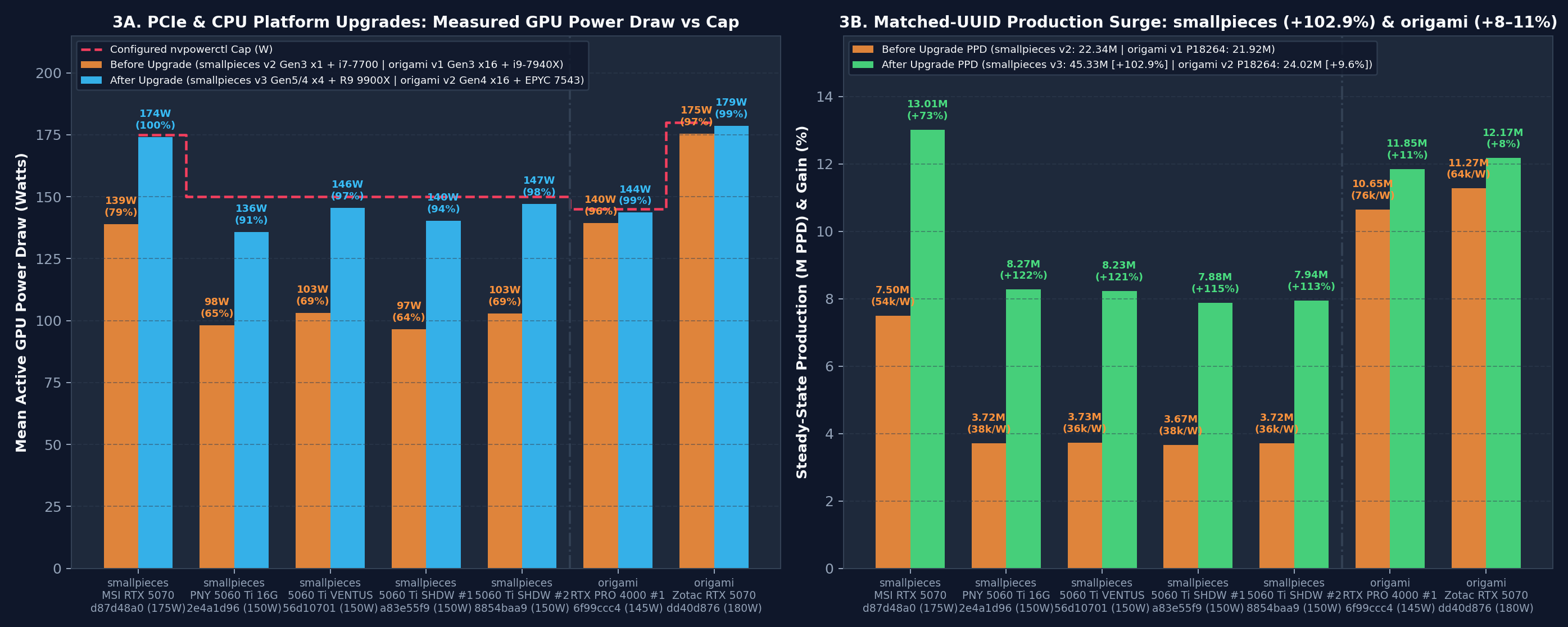
smallpieces v2 (i7-7700 + Octominer PCIe Gen 3 x1 backplane) to smallpieces v3 (Ryzen 9 9900X + PCIe Gen 5.0/4.0 x4) alongside the 2 Blackwell GPUs transplanted from origami v1 (i9-7940X + X299 PCIe Gen 3 x16) to origami v2 (EPYC 7543 + PCIe Gen 4 x16).🚀 3.1 The Bus-Starvation Wattage Paradox on smallpieces v2 → v3 (+102.9% PPD, +47.3% PPD/W)
- Why PCIe x1 Backplane + 4-Core CPU Starvation Masquerades as "Low Power Draw": On
smallpiecesv2, fourRTX 5060 Ticards sat in Octominer PCIe Gen 3.0 x1 powered backplane slots (~985 MB/slink bandwidth) while sharing a 4-core / 8-threadi7-7700CPU running at93.2%utilization across 6 concurrent GPUs. At every OpenMM frame boundary and PME reduction step, the GPUs stalled waiting for PCIe DMA transfers and CPU thread scheduling. Because GPU shaders drop to low-power idle states during host/bus stalls, the150W-cappedRTX 5060 Ticards averaged only96.6–103.1W(64–69%of cap) and the175W-cappedRTX 5070(in Slot 1 Gen 3 x16, but CPU-starved) averaged139.0W(79%of cap). - Unleashing Full Silicon Utilization on
smallpiecesv3: Moving those 5 GPUs onto an ADT-Link R34Ax4/x4/x4/x4bifurcation board (4xK43SM (2x 40cm + 2x 50cm)risers at PCIe Gen 5.0 x4 =~15.75 GB/sper card, 16x the bandwidth of Gen 3 x1) plusPCIEX16_2direct on the motherboard at PCIe Gen 4.0 x4 (~7.88 GB/s) and a 12-core / 24-threadRyzen 9 9900X(88.0WEco Mode) eliminated all DMA and CPU feeder stalls. EachRTX 5060 Tiimmediately rose to135.8–147.1W(91–98%of cap) and theRTX 5070rose to174.2W(99.5%of cap). - Super-Linear Efficiency Gain (
+38.3%to+60.7%HigherPPD/W): Because a stalled GPU still burns ~35–45W of fixed board/VRAM/PLL baseline power while producing zero math during DMA waits, eliminating bus stalls increased output (+102.9%PPD,22.34M → 45.33M PPD) 2.5x faster than power draw (+40.3%W,507.6W → 712.4Wmean). The 5-GPUsmallpiecesv3 array produces+64.2%more PPD than the 6-GPUsmallpiecesv2 array (which also had aZOTAC RTX 4070 Blowerinstalled).
⚡ 3.2 origami v1 (i9-7940X PCIe Gen 3.0 x16) → origami v2 (EPYC 7543 PCIe Gen 4.0 x16): +8.0% to +13.8% PPD & Cooler Temps
Even when GPUs are already seated in full x16 motherboard slots, upgrading from a 14-core Skylake-X i9-7940X (PCIe Gen 3.0 x16 = 15.75 GB/s, 19.25 MB L3 cache, mesh interconnect) on origami v1 to a 32-core Milan AMD EPYC 7543 (PCIe Gen 4.0 x16 = 31.5 GB/s, 256 MB L3 cache) on origami v2 produced a measurable, across-the-board speedup on the exact same physical NVIDIA RTX PRO 4000 Blackwell #1 (6f99ccc4, 145W cap) and ZOTAC GeForce RTX 5070 Solid OC (dd40d876, 180W cap) across 100,870+ neumon telemetry records and every matched Work Unit project:
- Higher Cap Utilization at Lower GPU Temperatures: On
origamiv2,RTX PRO 4000 Blackwell #1(6f99ccc4) power draw rose from139.5W(96.2%of cap,n=42,076) to143.6W(99.0%of cap,+4.1W,n=58,794) while its mean core temperature dropped by-4.4°C(78.8°C → 74.4°C) thanks to the Phanteks Enthoo Pro 2's13x Super Flower MEGACOOLfan array and dedicated vertical inter-GPU fan. Simultaneously,Zotac RTX 5070(dd40d876) power draw rose from175.4W(97.4%of cap,n=42,145) to178.7W(99.3%of cap,+3.3W,n=59,259) while running-2.5°Ccooler (61.0°C → 58.5°C). -5.2% to -12.4%Faster TPF &+8.0% to +13.8%Higher PPD Across Every Matched Project: Doubling slot bandwidth from PCIe Gen 3.0 x16 to PCIe Gen 4.0 x16 and expanding L3 cache 13.3x (19.25 MB → 256 MB) shaved2.0s to 9.0soff every frame across all four projects that ran on both versions oforigami.scrapsv1 (AX-B85M-ETHPCIe Gen 2.0 x1) →scrapsv2 (Octominer PCIe Gen 3.0 x1 Backplane): Doubling physical x1 slot bandwidth from500 MB/s(Gen 2.0 x1) to985 MB/s(Gen 3.0 x1) on the three matchedRTX 3060 TiGPUs reducedProject 15506TPF by-6.8%(59.47s → 55.4s) and boosted per-card PPD by+11.0% to +15.8%(2.83M → 3.14M–3.28M PPD).
| PLATFORM UPGRADE & GPU UUID | POWER CAP | BEFORE: LINK, WATTS & TEMP | BEFORE: PPD & TPF | AFTER: LINK, WATTS & TEMP | AFTER: PPD & TPF | PPD GAIN | PPD/W GAIN |
|---|---|---|---|---|---|---|---|
smallpieces v2→v3: MSI RTX 5070 (d87d48a0) |
175 W | Gen3 x16 (4C Starved) / 139.0W / 58.2°C | 7.50M (54.0k/W) | Gen5 x4 R34A Riser / 174.2W / 63.7°C | 13.01M (74.7k/W) | +73.5% | +38.3% |
smallpieces v2→v3: MSI 5060 Ti VENTUS (56d10701) |
150 W | Gen3 x1 Backplane / 103.1W / 55.1°C | 3.73M (36.2k/W) | Gen5 x4 R34A Riser / 145.6W / 64.1°C | 8.23M (56.5k/W) | +120.6% | +56.1% |
smallpieces v2→v3: MSI 5060 Ti SHADOW #1 (a83e55f9) |
150 W | Gen3 x1 Backplane / 96.6W / 54.4°C | 3.67M (38.0k/W) | Gen5 x4 R34A Riser / 140.4W / 66.8°C | 7.88M (56.1k/W) | +114.7% | +47.6% |
smallpieces v2→v3: PNY 5060 Ti 16GB (2e4a1d96) |
150 W | Gen3 x1 Backplane / 98.1W / 55.8°C | 3.72M (37.9k/W) | Gen5 x4 R34A Riser / 135.8W / 72.9°C | 8.27M (60.9k/W) | +122.3% | +60.7% |
smallpieces v2→v3: MSI 5060 Ti SHADOW #2 (8854baa9) |
150 W | Gen3 x1 Backplane / 102.9W / 53.2°C | 3.72M (36.2k/W) | Gen4 x4 Direct Slot / 147.1W / 63.1°C | 7.94M (54.0k/W) | +113.4% | +49.2% |
origami v1→v2: RTX PRO 4000 #1 (6f99ccc4, P18264) |
145 W | Gen3 x16 (i9-7940X) / 139.5W / 78.8°C | 10.65M / 141.7s TPF | Gen4 x16 (EPYC 7543) / 143.6W / 74.4°C | 11.85M / 132.7s TPF | +11.3% (-6.3% TPF) | +8.1% (-4.4°C) |
origami v1→v2: RTX PRO 4000 #1 (6f99ccc4, P18247) |
145 W | Gen3 x16 (i9-7940X) / 139.5W / 78.8°C | 10.64M / 55.5s TPF | Gen4 x16 (EPYC 7543) / 143.6W / 74.4°C | 11.99M / 52.6s TPF | +12.7% (-5.2% TPF) | +9.5% (-4.4°C) |
origami v1→v2: Zotac RTX 5070 (dd40d876, P18264) |
180 W | Gen3 x16 (i9-7940X) / 175.4W / 61.0°C | 11.27M / 138.3s TPF | Gen4 x16 (EPYC 7543) / 178.7W / 58.5°C | 12.17–12.52M / 130.6s | +8.0–11.1% (-5.6% TPF) | +6.0–9.0% (-2.5°C) |
origami v1→v2: Zotac RTX 5070 (dd40d876, P18247) |
180 W | Gen3 x16 (i9-7940X) / 175.4W / 61.0°C | 11.09M / 54.2s TPF | Gen4 x16 (EPYC 7543) / 178.7W / 58.5°C | 11.98M / 52.2s TPF | +8.0% (-3.7% TPF) | +6.0% (-2.5°C) |
scraps v1→v2: 3x RTX 3060 Ti Avg (P15506) |
125 W | B85 Gen2 x1 Slot / 115.3W / 57.6°C | 2.83M / 59.47s TPF | OX12U Gen3 x1 Slot / 119.8W / 57.1°C | 3.28M / 55.40s TPF | +15.8% (-6.8% TPF) | +11.5% |
4. GPU Architecture & Silicon Efficiency Matrix (Ada vs Blackwell vs Ampere vs Turing)
Correlating per-GPU NVML power draw and core temperatures from neumon with credited Work Unit PPD across all 18 physical GPUs that have operated in the fleet reveals a 6.0x spread in silicon efficiency between the flagship Ada Lovelace RTX 4090 (127.2k PPD/W) and the retired Turing RTX 2060 (21.0k PPD/W).
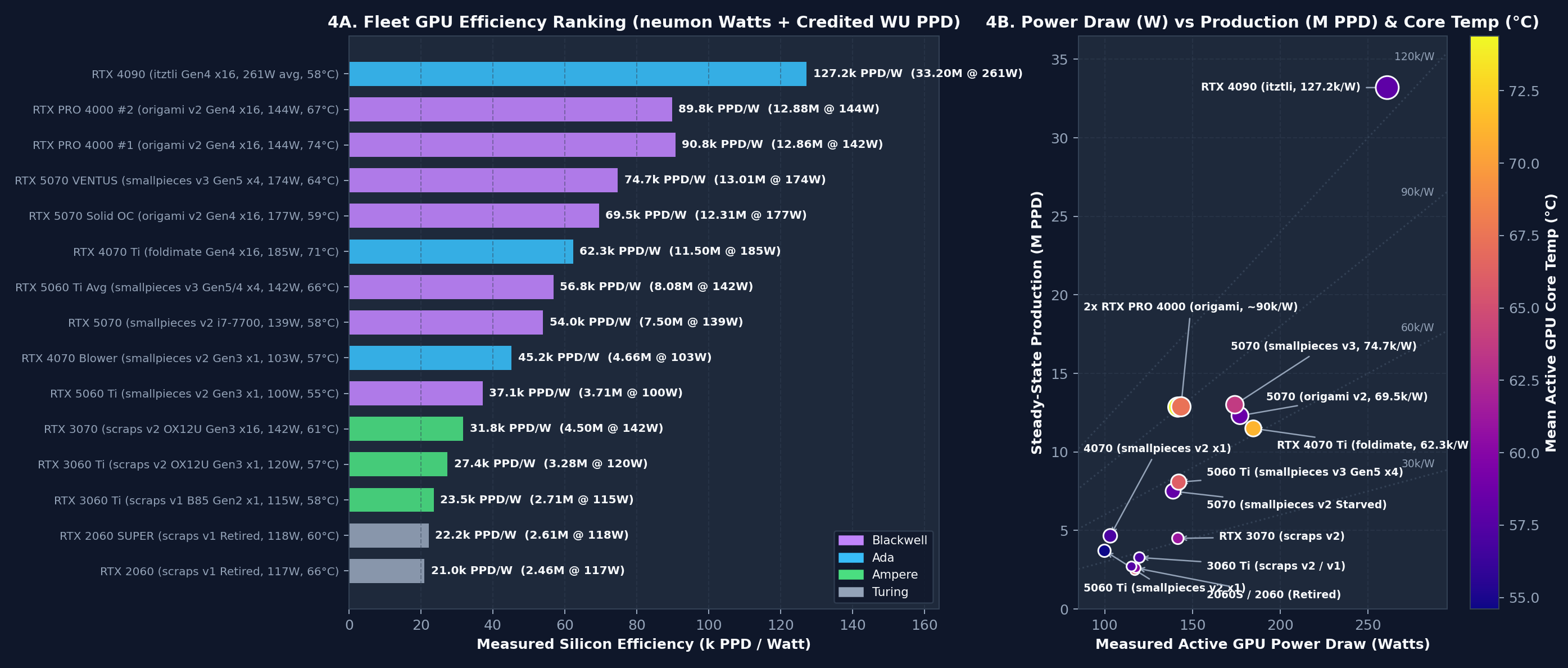
k PPD / Watt) across all fleet GPU tiers and bus configurations. (Right) Power draw (W) vs steady-state production (M PPD) colored by mean active GPU core temperature (°C).- Tier 1 — Flagship Ada Lovelace & Workstation Blackwell (
89.8k – 127.2k PPD/W):NVIDIA GeForce RTX 4090(itztli,315Wcap,261.0Wmean active draw @58.1°C):33.20M PPDat127.2k PPD/W(peaking above36M PPD/135k PPD/Won large beta WUs). Operating the AD102 die at ~58% of its 450W stock TGP places it deep in its voltage-efficiency sweet spot.2x NVIDIA RTX PRO 4000 Blackwell(origamiv2,145Wcap,141.7–143.6Wmean draw @67.4–74.4°C):12.86M–12.88M PPDeach at89.8k–90.8k PPD/Win single-slot workstation blower form factors.
- Tier 2 — Efficiency-Capped Consumer Blackwell & Ada (
54.0k – 74.7k PPD/W):MSI RTX 5070 VENTUS 2X OC(smallpiecesv3,174.2W@63.7°C) &ZOTAC RTX 5070 Solid OC(origamiv2,178.7W@58.5°C):12.31M–13.01M PPDat69.5k–74.7k PPD/W.ASUS RTX 4070 Ti(foldimate,195Wshift cap,184.7Wmean draw @71.2°C):11.50M PPDat62.3k PPD/W.4x RTX 5060 Tionsmallpiecesv3 (150Wcap,142.2Wmean draw @65.8°C):7.88M–8.27M PPDeach at54.0k–60.9k PPD/W.
- Tier 3 — Ampere Workhorses on
scrapsv2 (26.1k – 31.8k PPD/W):ZOTAC RTX 3070(145Wcap,141.6Wmean draw @60.9°Cin Octominer Slot 1 Gen 3 x16):4.50M PPDpeak /3.59M PPDmulti-project avg at25.4k–31.8k PPD/W.3x RTX 3060 Ti(125Wcap,119.8Wmean draw @57.1°Cin Octominer Gen 3 x1 backplane Slots 4, 7, 10):3.10M–3.28M PPDeach at26.1k–27.4k PPD/W(up+11.5%in efficiency overscrapsv1's Gen 2 x1 motherboard).
- Tier 4 — Retired Turing Cards (
21.0k – 22.2k PPD/W— De-Allocated Aug 29, 2026):Gigabyte RTX 2060 SUPER(117.8W@60.4°C,2.61M PPD,22.2k PPD/W) andASUS RTX 2060(117.2W@66.0°C,2.46M PPD,21.0k PPD/W) burned235.0Wof continuous GPU power (~285Wat the wall /973 BTU/hr) for just5.07M PPDcombined—less than 40% of a single142WRTX PRO 4000 Blackwell. Retiring them in Era 11 raised fleet-wide GPU efficiency by+24.3%overnight.
5. Controlled RAM Speed Evaluation (origami v2 A/B Test, Planned smallpieces v3 Test & Host RAM Capacity Cliffs)
Evaluating whether system DRAM clock speed affects GPU Folding@Home PPD requires strict apples-to-apples hardware isolation—holding the CPU, motherboard, PCIe lane topology, and physical GPU silicon UUIDs constant while varying only memory frequency. Cross-host comparisons (such as comparing scraps v1 vs v2 or origami v2 vs smallpieces v3) are confounded by simultaneous changes in PCIe generation, CPU IPC, and GPU boost curves and therefore cannot isolate RAM speed.
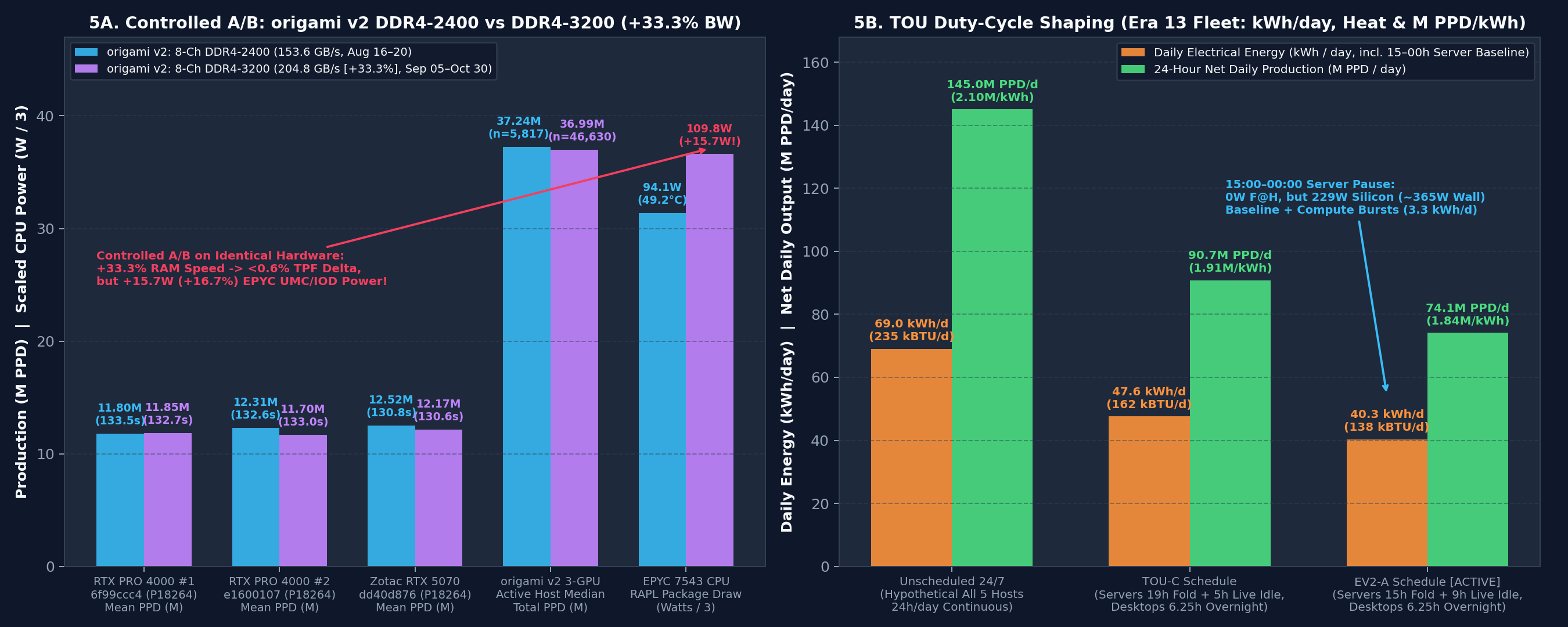
origami v2 (8-Channel DDR4-2400 vs 8-Channel DDR4-3200 across 614 Project 18264 WUs and 52,447 neumon samples). (Right) Daily energy (kWh/day), heat (kBTU/day), and net production (M PPD/day) across utility rate-plan schedules.🧪 5.1 Controlled Apples-to-Apples A/B Test: origami v2 8-Channel DDR4-2400 vs DDR4-3200 (+33.3% RAM Speed)
When origami v2 (AMD EPYC 7543 + ASRock Rack ROMED8-2T + 2x RTX PRO 4000 Blackwell + 1x Zotac RTX 5070) first launched on August 16, 2026, its 256GB memory kit contained seven Samsung M393A4K40BB1-CRC (DDR4-2400) RDIMMs and one DDR4-3200 module, forcing all 8 memory channels to train at 2400 MT/s (153.6 GB/s peak theoretical bandwidth) through August 20. Between August 21 and September 5, the mismatched kit was RMA-replaced with eight matched 32GB Micron 36ASF4G72PZ-3G2R1 DDR4-3200 ECC RDIMMs running in 8-channel mode at 3200 MT/s (204.8 GB/s — exactly +33.3% higher memory clock and bandwidth) on the exact same CPU, motherboard, PCIe 4.0 x16 slots, and GPUs:
| BENCHMARK METRIC / GPU UUID | 8-CH DDR4-2400 (153.6 GB/s) Aug 16 – Aug 20, 2026 |
8-CH DDR4-3200 (204.8 GB/s) Sep 05 – Oct 30, 2026 |
MEASURED DELTA | PHYSICAL & TELEMETRY INTERPRETATION |
|---|---|---|---|---|
P18264 — RTX PRO 4000 #1 (6f99ccc4) |
133.53s TPF / 11.80M PPD (n=9) | 132.71s TPF / 11.85M PPD (n=188) | -0.62% TPF / +0.45% PPD | Statistically indistinguishable (<0.8s on a 133s frame). |
P18264 — RTX PRO 4000 #2 (e1600107) |
132.63s TPF / 12.31M PPD (n=8) | 132.99s TPF / 11.70M PPD (n=191) | +0.27% TPF | Zero frame speedup from +33.3% DRAM clock/bandwidth. |
P18264 — Zotac RTX 5070 (dd40d876) |
130.82s TPF / 12.52M PPD (n=15) | 130.56s TPF / 12.17M PPD (n=203) | -0.20% TPF | Identical 130.6s–130.8s frame time at 180W cap. |
3-GPU Host Median / P90 PPD (neumon) |
37.24M med / 38.94M p90 (n=5,817) | 36.99M med / 39.05M p90 (n=46,630) | -0.67% med / +0.28% p90 | Across 52,447 active 3-GPU samples, total output is flat. |
| EPYC 7543 CPU Package Power (RAPL) | 94.1 W mean (49.2°C CPU) | 109.8 W mean (49.3°C CPU) | +15.7 W (+16.7% CPU W) | Higher Infinity Fabric (FCLK 1200 → 1600 MHz) + 8-ch UMC/RDIMM I/O burns +15.7W continuously for 0% PPD gain! |
🔬 5.2 Scope of the 8-Channel EPYC Result & Planned 2-Channel smallpieces v3 A/B Experiment (DDR5-6000 → DDR5-4800)
- Why
origamiv2 Only Bounds High-Bandwidth 8-Channel Platforms: Becauseorigamiv2 uses an 8-channel server memory bus, even its slowerDDR4-2400configuration provides153.6 GB/sof theoretical bandwidth (already higher than a dual-channelDDR5-6000desktop bus at96.0 GB/s) alongside a massive256 MBL3 cache. Thus,origamiv2 proves that raising system memory bandwidth above153.6 GB/syields zero F@H frame speedup while costing+15.7Wof memory-controller/Infinity-Fabric power—but it does not by itself rule out RAM clock sensitivity on a 2-channel desktop platform feeding 5 GPUs. - Planned Follow-Up Controlled Experiment on
smallpiecesv3 (DDR5-6000vsDDR5-4800): To obtain an equally rigorous apples-to-apples test on a 2-channel desktop platform,smallpiecesv3 (Ryzen 9 9900X+ 5 Blackwell GPUs) can be stepped down in UEFI fromDDR5-6000(96.0 GB/s) toDDR5-4800(76.8 GB/s,-20%bandwidth) with all other hardware and power caps held constant, comparing matched-project TPF, PPD, andRyzen 9 9900XSoC/UMC power draw. - Host RAM Capacity & Allocation Cliffs (Distinct from RAM Clock Speed):
- The 8GB RAM Swap Cliff (
AX-B85M-ETHonsmallpiecesv1 &scrapsv1): When 4–5 GPUs folded simultaneously on the legacy8GB DDR3motherboard, host memory pressure triggeredkswapd0andzswapdisk thrashing ("iowait hell"), stalling GPU feeders and cutting PPD by25–50%. - OpenMM Hidden CPU Sanity-Check Thread Inflation (
OPENMM_CPU_THREADS=4): Every 5% of a Work Unit,FahCore_27initializes a hidden OpenMMCPUplatform context to sanity-check GPU forces. By default, OpenMM spawns4 × N_CPU_threads + 8threads and heap buffers per GPU—consuming25.95 GiBRSS across 5 GPUs on 24-threadsmallpiecesv3 (81%of 32GB RAM). SettingOPENMM_CPU_THREADS=4in/opt/docker-configs/fah-compose.yamlslashed 5-GPU host RSS to~14.0 GiB(-12 GiBsaved) with0.0%TPF or PPD impact.
- The 8GB RAM Swap Cliff (
6. Datacloset Thermodynamics, HVAC Zone Partitioning (1-Ton Mini-Split vs Attic Chimney vs 3-Ton Carrier Heat Pump), 240V Cutover & Audimute Acoustic/Thermal Isolation
Silicon efficiency only tells half the thermal story; the other half is how 10,220 BTU/hr (~2,995W AC wall) of concurrent fleet heat is physically evacuated without overwhelming room ambient temperatures or household acoustics. The fleet is partitioned across three distinct physical cooling zones:
- The Datacloset Room Air Zone (
13' H × 7' W × 4' D=364 cu ft/10.31 m³): Cooled by a dedicated 1-ton (12,000 BTU/hr/3,517Wthermal) mini-split AC (live May 15, 2026) assisted by a bottom door inlet louver/vent (centered in the7 ftwall) and a ceiling Panasonic WhisperQuiet110 CFMbathroom exhaust fan (providing18.1 air changes per hour [ACH]). In addition to its assigned folding servers, the datacloset houses an always-on~125W(427 BTU/hr) infrastructure rack: 1x NAS, 2x ISP modems, 1x Netgate 4100 firewall, 1x Intel NUC (m), 1x 24-port 1G switch, and 2x mesh Wi-Fi nodes (1 trusted, 1 untrusted). - The Datacloset Attic Chimney Exhaust Zone: A vertical chimney duct inside the datacloset captures hot exhaust directly off the Octominer server chassis and vents it straight into the attic, where a thermostatically controlled attic fan evacuates stored heat outdoors through gable vents—preventing ~85% of the chimney-ducted host's heat (
~1,711–2,360 BTU/hr) from ever entering the datacloset room air or loading the 1-ton mini-split. - The Main House Zone (
itztli&foldimate): Cooled by the main house HVAC—originally traditional forced-air HVAC, and since May 15, 2026 a whole-house 3-ton (36,000 BTU/hr) Carrier high-efficiency heat pump that went online on the same day as the datacloset mini-split.
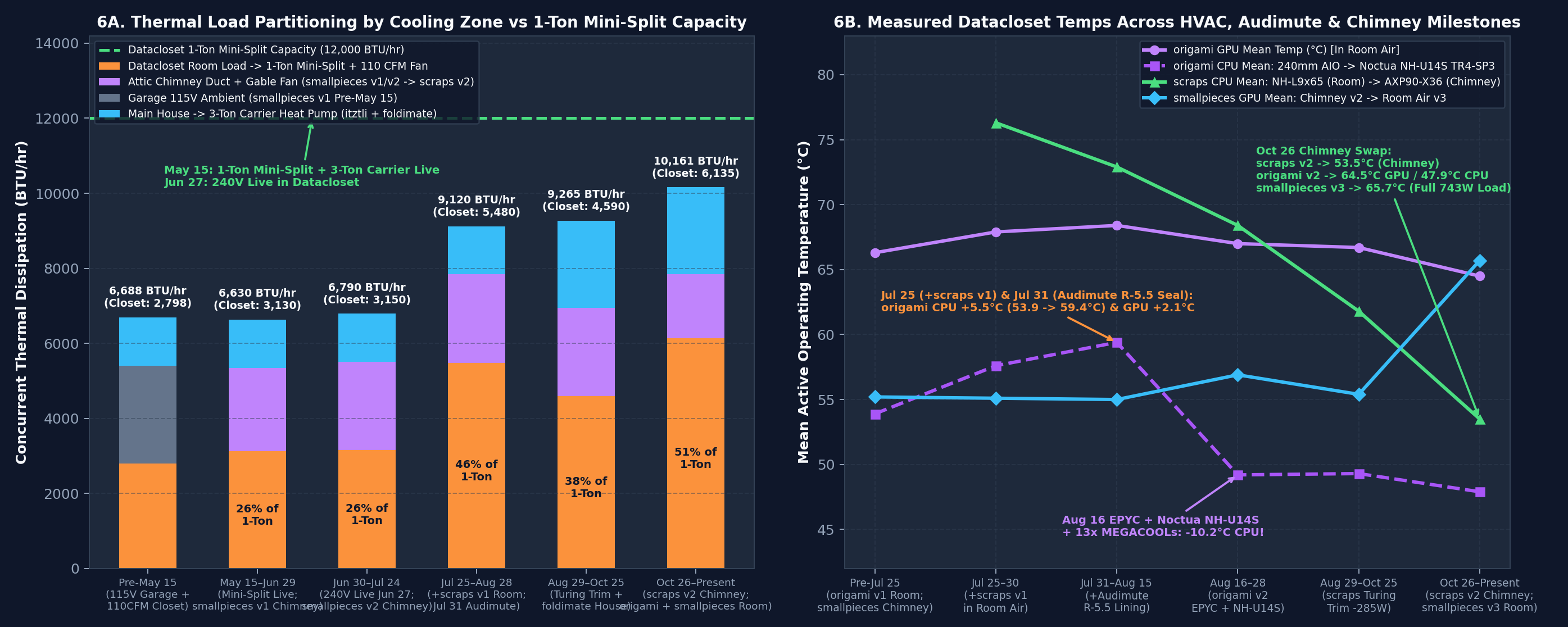
BTU/hr) partitioned across the datacloset 1-ton mini-split room air zone, the attic chimney duct, the pre-May 15 garage zone, and the main-house 3-ton Carrier heat pump. (Right) Measured neumon CPU and GPU operating temperatures across every datacloset HVAC, Audimute acoustic lining, and chimney-swap milestone.🏗️ Chronological Facility, Electrical (240V) & Acoustic (Audimute) Engineering Milestones
- Pre–May 15, 2026 (
115VGarage + Exhaust-Only Datacloset): Prior to May 15,origamiv1 and the network/NAS gear (~2,798 BTU/hrtotal) operated in the datacloset cooled solely by make-up house air through the door inlet louver and the ceiling110 CFMWhisperQuiet exhaust fan, whilesmallpiecesv1 ran in the garage on115Vpower (~2,610 BTU/hr). - May 15, 2026 (1-Ton Datacloset Mini-Split + Attic Chimney + 3-Ton Main-House Carrier Heat Pump Online): Commissioning the 1-ton (
12,000 BTU/hr) mini-split allowedsmallpiecesv1 to move from the garage into the datacloset on the attic chimney duct. Because the chimney + attic gable fan evacuated~2,220 BTU/hrdirectly into the attic, the 1-ton mini-split only had to handleorigamiv1 (~2,371 BTU/hr) + the network/NAS stack (427 BTU/hr) + ~15% chimney conductive bleed (~332 BTU/hr) =3,130 BTU/hr(just26.1%of the mini-split's 1-ton capacity). - June 27, 2026 (
240VPower Energized in the Datacloset): Three days prior to the June 30smallpiecesv2 Octominer X12 Ultra cutover, dedicated240Vcircuits went live in the datacloset. Runningorigami'sCorsair AX1600i(80+ Titanium) and the Octominer's4x HPE 750W Platinum Plusserver PSUs on240Vinstead of115Vimproved AC-to-DC PSU conversion efficiency by+2–3%(shedding~50–65W/~190 BTU/hrof waste PSU heat) and cut branch-circuit current in half. - July 25, 2026 (
scrapsv1 Added Un-Ducted in Datacloset Room Air —+2,330 BTU/hrRoom Spike):scrapshas only ever operated in the datacloset. Becausesmallpiecesv2 occupied the attic chimney, bringingscrapsv1 (5 GPUs + Haswelli7-4790in the open GPNE frame,~725Wwall /2,474 BTU/hr) online discharged its heat directly into the room air alongsideorigamiv1—raising datacloset room load from3,150to5,480 BTU/hr(45.7%of 1-ton capacity). Inneumontelemetry (Jul 25–30),origamiv1's mean GPU temperature immediately rose by+1.6°C(66.3°C → 67.9°C) and its 240mm AIO CPU temperature rose by+3.7°C(53.9°C → 57.6°C). - July 31, 2026 (
AudimuteAcoustic Lining & Perimeter Door Seal Installed): To isolate server fan noise from the living space, the13' H × 7' W × 4' Ddatacloset was lined with three commercial Audimute acoustic treatments:AcoustiFelt™ Fabric Acoustic Shapes(SKU: FH-400-400-C, Aluminum Felt Planks,1.5"thickness,0.95 NRC, Qty6packs): Absorbs 95% of incident mid/high-frequency acoustic energy (500–4,000 Hz), eliminating parallel-wall flutter echo across the narrow4 ftroom depth.Peacemaker® Sound Barrier — 3 mm(SKU: APM64000851,2' × 18'=36 sq fthigh-density recycled rubber barrier roll): Adds mass-loaded transmission loss against low-frequency chassis resonance.Acoustic Door Seal Kit(SKU: ASLK0000780, Standard Interior Door Perimeter Seal): Seals acoustic leaks around the centered interior door perimeter while channeling make-up airflow strictly through the lower door inlet louver.
Jul 31 – Aug 15): Because1.5"of dense AcoustiFelt +3mmrubber barrier adds~R-5.5of thermal insulation over the drywall and seals door perimeter air gaps, conductive heat transfer through the closet walls into the house dropped to near zero. Retaining 100% of the heat inside the closet envelope for the mini-split and110 CFMceiling fan nudgedorigamiv1's GPU mean up by+0.5°C(67.9°C → 68.4°C) and CPU mean up by+1.8°C(57.6°C → 59.4°C). - October 26–29, 2026 (The Great Chimney Swap:
scrapsv2 Now Chimney-Vented;origamiv2 +smallpiecesv3 Cooled by the 1-Ton Mini-Split): Transplantingscrapsv2 (1x RTX 3070 + 3x RTX 3060 Ti,~590Wwall /2,013 BTU/hr) into the enclosed Octominer X12 Ultra placedscrapsv2 on the attic chimney duct (evacuating~1,711 BTU/hrto the attic and droppingscraps's CPU mean to53.5°C). The 1-ton mini-split now coolsorigamiv2 (2,201 BTU/hr) +smallpiecesv3 (3,207 BTU/hrin the vertical GPNE wind-tunnel) + Network/NAS rack (427 BTU/hr) + 15% chimney bleed (302 BTU/hr) =6,135 BTU/hr(51.1%of the 1-ton mini-split's12,000 BTU/hrcapacity, leaving5,865 BTU/hrof thermal headroom). - November 13, 2026 (
smallpiecesv3.1 Acoustic & PWM Upgrade: DualAlphacool ES GuardianHubs +1"AudimutePSU Hush Box): Replaced the GPNE frame's manual dial fan hubs with two motherboard-controlled Alphacool ES Guardian 4-Port Powerfan Hubs (CHA_FAN2Intake &CHA_FAN1Exhaust on Nuvotonnct6799, driving8x M12038120x38mm 1.50Afans undergpufanpin v1.4.0positional PWM curves:~850 / 1,518 RPMoff-shift idle,~2,195 / 2,292 RPM5-GPU load,100%open-collector failsafe on PWM loss /S5soft-off), and fabricated a custom1"Audimute Eco-C-Tex acoustic hush box over theLX2400W2400W server PSU exhaust bay to tame its high-frequency internal PSU fan whine.
| FACILITY & HVAC ERA | DATACLOSET ROOM AIR ZONE (1-Ton Mini-Split + 110 CFM Fan) |
ATTIC CHIMNEY ZONE (Duct + Attic Gable Fan) |
CLOSET ROOM BTU/hr (% OF 1-TON AC) |
CHIMNEY ATTIC BTU/hr | MAIN HOUSE BTU/hr (3-Ton Carrier) |
MEASURED DATACLOSET THERMAL RESPONSE (neumon) |
|---|---|---|---|---|---|---|
| Pre–May 15, 2026 115V Garage + 110 CFM Closet |
origami v1 + Net/NAS rack (110 CFM exhaust fan only; no AC) |
None (smallpieces v1 in Garage on 115V: 2,610 BTU/hr) |
2,798 BTU/hr (No AC yet) |
0 BTU/hr | 1,280 BTU/hr ( itztli) |
Baseline 115V regime before mini-split and chimney ducting. |
| May 15 – Jun 29 Mini-Split + Chimney Live |
origami v1 + Net/NAS rack |
smallpieces v1 (GPNE chimney-ducted to attic) |
3,130 BTU/hr (26.1% of 1-Ton) |
2,220 BTU/hr | 1,280 BTU/hr ( itztli) |
1-ton mini-split & 3-ton Carrier heat pump online May 15; 240V energized June 27. |
| Jun 30 – Jul 24 smallpieces v2 Octominer |
origami v1 + Net/NAS rack |
smallpieces v2 (Octominer X12 Ultra on 240V) |
3,150 BTU/hr (26.3% of 1-Ton) |
2,360 BTU/hr | 1,280 BTU/hr ( itztli) |
origami v1 runs cool at 66.3°C GPU mean / 53.9°C CPU mean; smallpieces v2 at 55.2°C GPU. |
| Jul 25 – Aug 15 +scraps v1 Room & Audimute |
origami v1 + scraps v1 (un-ducted) + Net/NAS rack |
smallpieces v2 (Octominer X12 Ultra) |
5,480 BTU/hr (45.7% of 1-Ton) |
2,360 BTU/hr | 1,280 BTU/hr ( itztli) |
Un-ducted scraps v1 + Jul 31 Audimute R-5.5 seal raises origami v1 CPU +5.5°C (53.9→59.4°C) & GPU +2.1°C. |
| Aug 16 – Aug 28 origami v2 EPYC Rebuild |
origami v2 (EPYC + 13x MEGACOOLs) + scraps v1 + Net/NAS |
smallpieces v2 (Octominer X12 Ultra) |
5,310 BTU/hr (44.3% of 1-Ton) |
2,360 BTU/hr | 1,280 BTU/hr ( itztli) |
origami v2 Noctua NH-U14S TR4-SP3 + 13x MEGACOOL fans drops origami CPU temp by -10.2°C (59.4→49.2°C)! |
| Aug 29 – Oct 25 scraps Turing Trim (-285W) |
origami v2 + scraps v1 (3-GPU) + Net/NAS rack |
smallpieces v2 (Octominer X12 Ultra) |
4,590 BTU/hr (38.3% of 1-Ton) |
2,360 BTU/hr | 2,315 BTU/hr ( itztli + foldimate) |
Removing 285W (973 BTU/hr) of Turing heat from room air drops scraps v1 CPU temp by -6.6°C (68.4→61.8°C). |
| Oct 26 – Present Chimney Swap: scraps v2 + smallpieces v3 |
origami v2 + smallpieces v3 + Net/NAS rack |
scraps v2 (Octominer X12 Ultra) |
6,135 BTU/hr (51.1% of 1-Ton) |
1,711 BTU/hr | 2,315 BTU/hr ( itztli + foldimate) |
scraps v2 chimney-cooled at 53.5°C CPU; origami v2 hits all-time low 64.5°C GPU / 47.9°C CPU alongside smallpieces v3 (65.7°C). |
7. Utility Time-of-Use (TOU) Duty-Cycle Shaping: Daily Energy (kWh/day), Live Baseline & Thermal Load
While instantaneous efficiency is governed by silicon power caps and PCIe bus architecture, 24-hour cumulative heat and energy consumption are governed by automated systemd shift timers (fah-start / fah-stop). During the EV2-A peak/part-peak window (15:00–00:00, 9 hours/day), Folding@Home is paused across all fleet hosts (0 W of F@H folding load), and the two high-wattage desktop rigs (itztli, foldimate) fold strictly during the coolest overnight off-peak hours (00:00–06:15, 6.25 hours/day). However, the three dedicated datacloset servers (origami, smallpieces, and scraps) remain live and online 24/7, drawing continuous baseline idle power during 15:00–00:00 while origami and smallpieces also serve intermittent, VRAM-resident multi-GPU compute workloads whose CPU and GPU power draw oscillates during active bursts:
LIVE SERVER HOST (15:00–00:00 F@H PAUSE WINDOW) |
VRAM RESIDENT | QUIESCENT CPU IDLE (p50) | QUIESCENT GPU IDLE (p25–p50) | QUIESCENT SILICON / WALL | COMPUTE BURST SILICON (p50 / p90 / MAX) | PAUSED-WINDOW TELEMETRY BEHAVIOR (47,030 neumon SAMPLES) |
|---|---|---|---|---|---|---|
origami v2EPYC 7543 + 2x PRO 4000 + RTX 5070 |
54.3 GiB / 64 GiB ( 22.8+9.8+21.7 GiB) |
74.1 W (EPYC SoC/RDIMM) |
25.0 W ( 5.9+13.7+5.7W) |
99.2 W Silicon ~140 W Wall (478 BTU/h) |
291.9 W / 348.7 W / 467.9 W GPUs: 157–255W | CPU: 91–170W |
Holds 54.3 GiB resident in P8 idle (31–32°C). Multi-minute compute bursts (n=478 samples, 3.8% of paused ticks) ramp all 3 GPUs (29–52W each) + EPYC CPU (91–171W). |
smallpieces v3 (and v2)9900X + 1x 5070 + 4x 5060 Ti |
49.3 GiB / 52 GiB ( 11.6+15.6+3x7.4 GiB) |
45.3 W (v3) 13.7 W (v2 i7-7700) |
28.2 W (v3) 32.6 W (v2 6-GPU) |
73.6 W Silicon (v3) ~115 W Wall (392 BTU/h) |
~180 W / ~195 W / ~215 W (v3) v2: 136.7W med / 149.1W max |
Holds 49.3 GiB resident across 5 GPUs (27–29°C). Short interactive bursts (<15s) usually fall between 60s neumon ticks; caught bursts ramp all GPUs to 20–28W each (~136W GPU total). |
scraps v2 (and v1)i7-7700 + 1x 3070 + 3x 3060 Ti |
4 MiB / 32 GiB ( 1 MiB per GPU) |
6.7 W (v2) 11.0 W (v1 i7-4790) |
36.5–49.6 W (v2) 63.3 W (v1) |
56.5 W Silicon (v2) ~95 W Wall (324 BTU/h) |
None (Pure Idle) 56.5 W Silicon / ~95 W Wall |
Pure F@H worker. Idles continuously in P8 state (30–34°C GPU, 800 MHz C-state CPU at 6.7W) throughout the 15:00–00:00 pause window. |
| Combined 3-Server Datacloset Total Era 13 Live During 15:00–00:00 Pause |
103.6 GiB Across 8 Blackwell GPUs |
126.1 W Combined CPU Idle |
103.2 W 12-GPU P8 Idle |
229.3 W Silicon ~350 W Wall (1,194 BTU/h) |
~365 W Avg AC Wall Bursts: 380–520W Silicon |
Sheds -1,814 W (-83.2%) of server AC wall load vs active folding (2,179 W), consuming 3.3 kWh/day (11.2 kBTU/day) across the 9-hour pause window. |
| OPERATING SCHEDULE & FLEET REGIME | SERVER FOLDING DUTY | DESKTOP FOLDING DUTY | PAUSED SERVER BASELINE (kWh/d) | TOTAL DAILY ENERGY (kWh/day) | DAILY HEAT (kBTU/day) | NET DAILY OUTPUT (M PPD/day) | ENERGY EFFICIENCY (M PPD / kWh) |
|---|---|---|---|---|---|---|---|
| Era 13 Hypothetical 24/7 Unscheduled All 5 Hosts Folding 24 Hours/Day |
24.0 h (100%) | 24.0 h (100%) | 0.0 kWh/d (0h pause) | 71.9 kWh/day | 245.3 kBTU/day | 145.0M PPD/day | 2.02M PPD/kWh |
| Era 9 Under Legacy TOU-C Schedule 15 GPUs (Pre-Turing Trim, 16:00–21:00 Pause) |
19.0 h (79.2%) | 6.25 h (26.0%) | 1.6 kWh/d (5h @ ~310W) | 46.4 kWh/day | 158.3 kBTU/day | 68.9M PPD/day | 1.48M PPD/kWh |
| Era 11 Under EV2-A Schedule 13 GPUs (Post-Turing Trim, 15:00–00:00 Pause) |
15.0 h (62.5%) | 6.25 h (26.0%) | 2.9 kWh/d (9h @ ~325W) | 33.7 kWh/day | 115.0 kBTU/day | 60.9M PPD/day | 1.81M PPD/kWh |
| Era 13 Live Under Active EV2-A Schedule 14 GPUs ( smallpieces v3 + scraps v2 + origami v2 + itztli + foldimate) |
15.0 h (62.5%) | 6.25 h (26.0%) | 3.3 kWh/d (9h @ ~365W) | 40.3 kWh/day | 137.5 kBTU/day | 74.8M PPD/day | 1.86M PPD/kWh |
- Peak-Window Thermal & Energy Relief (
-43.9%Daily kWh & Heat vs 24/7, Shedding83.2%of Server Load During15:00–00:00): Pausing F@H on the three dedicated servers (origami,smallpieces,scraps) during the warmest afternoon/evening utility window (15:00–00:00) eliminates100%of F@H folding watts and drops 3-server AC wall draw from2,179 W(7,435 BTU/hr) to a229.3 Wquiescent silicon baseline (~350 WAC wall,~365 Wtime-averaged with intermittent multi-GPU compute bursts, or1,194–1,245 BTU/hr). Combined with running the two high-wattage desktop rigs (itztli,foldimate) strictly during the coolest overnight off-peak hours (00:00–06:15), the Era 13 fleet consumes40.3 kWh/day(137.5 kBTU/day, including3.3 kWh/dayduring the 9-hour server pause window) instead of71.9 kWh/day(245.3 kBTU/day)—a-43.9%reduction in total daily heat and electrical energy. - Why 60-Second
neumonTelemetry Under-Samples Short Compute Oscillations: Even with54.3 GiBof VRAM allocated onorigamiv2 and49.3 GiBallocated onsmallpiecesv3, Blackwell GPUs drop smoothly into hardware P8 idle (2.5–13.7 Wper card,25.0–29.1 Wper host) whenever compute kernels are not actively executing. Sustained multi-minute compute bursts onorigamiv2 are readily captured byneumon's 60-second polling interval (n=478samples ramping to291.9 Wmedian /348.7 Wp90 silicon), whereas shorter sub-minute interactive bursts onsmallpiecesfrequently complete between 60-second sample ticks (capturingn=12mid-burst snapshots at136.7 Wmedian /149.1 Wmax silicon on v2). - Era 13 EV2-A Surpasses Era 9 TOU-C Output on
-13.1%Less Daily Energy: Even though the EV2-A server folding window is 4 hours shorter per day than the old TOU-C schedule (15hvs19h) and carries 4 extra hours of live server baseline draw, the Era 13 fleet produces+8.6%more net daily points (74.8Mvs68.9M PPD/day) while consuming-6.1 kWh/day(-13.1%,40.3vs46.4 kWh/day) less electricity and generating-20.8 kBTU/dayless heat—a+25.7%improvement in net daily energy efficiency (1.48M → 1.86M PPD/kWh).